
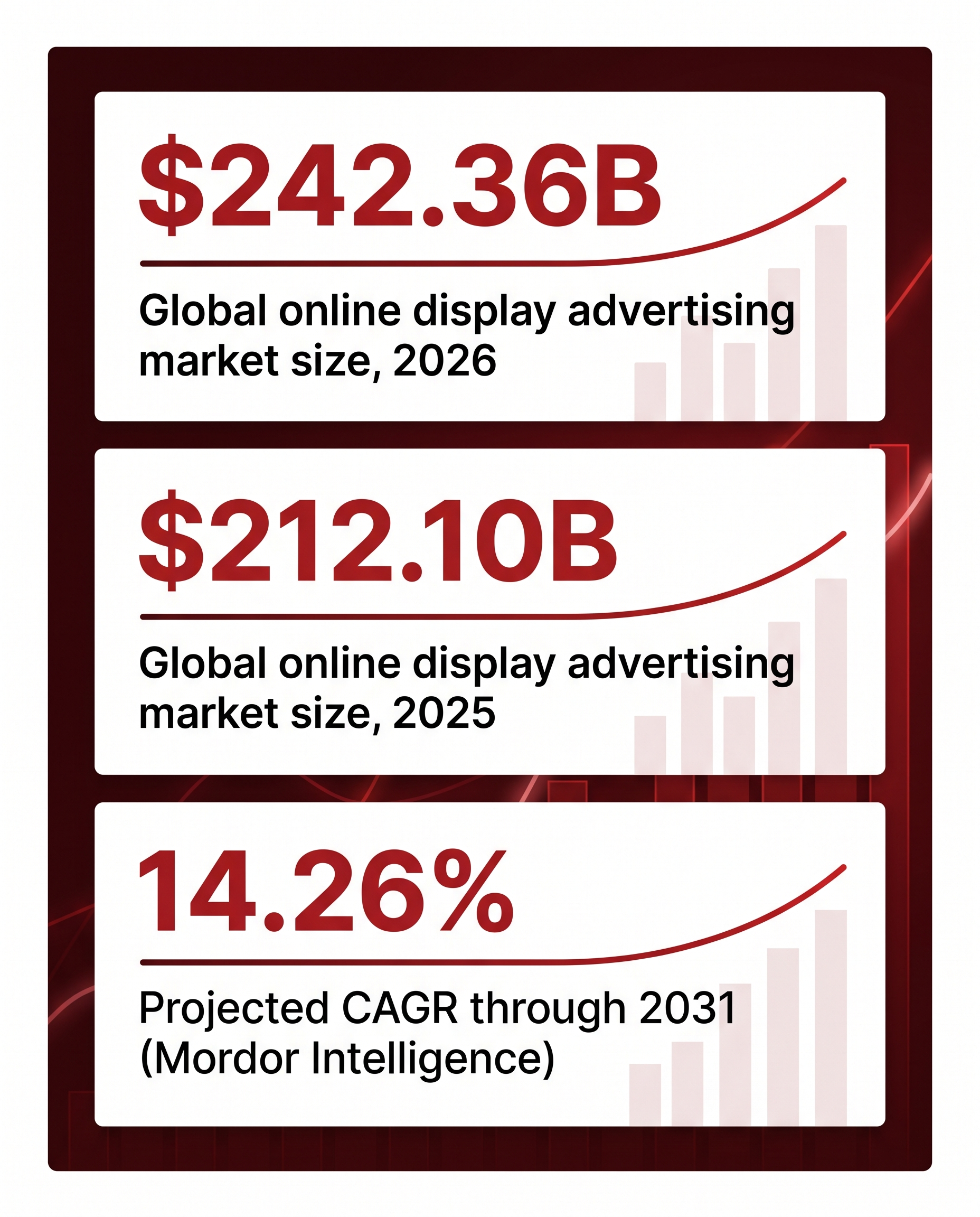
The global online display advertising market is on track to hit $242.36 billion in 2026, up from $212.10 billion in 2025 - a 14.26% compound annual growth rate through 2031, according to Mordor Intelligence.
Nearly all of that spend still routes through one of two structural formats: the static, in-page banner or the attention-grabbing pop-up. Picking the wrong one for your goal wastes budget fast.The TrafficSigma team runs both formats at scale across 248+ GEOs, so this guide breaks down banner advertising and pop-up advertising side by side - sizes, CTR/CPM benchmarks, and exactly when each format earns its place in a media plan - before you commit spend to either one.
The framework: three models that separate display ads vs. pop up ads
There's no universal winner between banner advertising and pop-up advertising - the right pick depends on what you're optimizing for. Before comparing numbers, it helps to understand the three structural models that every display ad format falls into, because banner ads and pop-ups sit at opposite ends of two of them and pop-unders occupy a third that's frequently confused with pop-ups.
The three models that structure this whole comparison:
- In-page, co-existing placements. The ad occupies a defined slot inside the page layout (a sidebar, a header strip, an in-content block) and renders alongside the content the user came for. Standard IAB banner sizes - 300x250, 728x90, 160x600, 320x50 - all fall here. The user never has to act on the ad to keep reading; it's passive, low-friction, and brand-safe by design.
- Interstitial, front-of-window placements. The ad takes over the active browser window, either as a full pop-up layered directly on top of the current page or as a fully separate new window the user must close or interact with before returning to their original task. This is the pop-up model - high-attention, high-friction, and built for a forced impression rather than a passive one.
- Interstitial, behind-of-window placements (popunder). A variant of the interstitial model where the new window opens behind the active browser window instead of in front of it, so it's invisible until the user closes or minimizes their current tab. This is mechanically a pop-up cousin, not the same format - see the terminology section below - and it's the dominant model behind most high-volume performance/CPA traffic today.
Which model wins depends on the answer to one question: are you protecting brand perception and reader experience (model 1), or maximizing raw click volume and conversion opportunities regardless of user annoyance tolerance (models 2 and 3)? Everything below is built to help you answer that for your own campaign.
Get iGaming traffic from TrafficSigma now!
Banner advertising: sizes, mechanics, and where it fits
Banner ads are the oldest surviving format in display advertising, and the Interactive Advertising Bureau (IAB) has spent two decades standardizing their dimensions so the same creative renders predictably across publishers, ad servers, and exchanges.
Standard banner ad sizes (IAB)
The IAB's ad unit portfolio still treats a small set of fixed-pixel units as the practical cross-publisher defaults, even as the IAB's newer flexible/aspect-ratio guidance rolls out for richer formats. The five sizes that account for the large majority of programmatic display volume:
- 300x250 (Medium Rectangle): the highest-volume unit in display advertising, effective in-content and in sidebars on both desktop and mobile.
- 728x90 (Leaderboard): the standard desktop header/footer banner, wide enough for a clear brand message plus a CTA.
- 160x600 (Wide Skyscraper): a tall sidebar unit that stays in view longer as a user scrolls a long page.
- 300x600 (Half Page): a large-format unit for higher-impact desktop placements, increasingly used for richer creative.
- 320x50 (Mobile Banner): the standard mobile leaderboard, built for the sub-header or sticky-footer slot on phones.
How banner ads perform
Banner advertising is a volume-and-frequency game, not a single-click game. Cross-industry benchmark aggregations, compiled from various ad-server and display-network reporting, generally put average banner CTR somewhere in the 0.05%-0.5% range, with real-estate, automotive, and finance verticals trending toward the top of that band and generic run-of-network placements toward the bottom - treat this as a directional range rather than an audited industry figure, since methodologies vary by source. CPMs for standard banner inventory typically land in the low single-digit dollars on open exchanges, rising sharply for premium, brand-safe, above-the-fold placements.
That low CTR isn't a flaw - it's the tradeoff for the format's biggest strength: banners don't interrupt the user, which protects both brand perception and publisher user-experience metrics. A banner that never gets clicked is still doing its job if the campaign goal is impression-based brand awareness or retargeting reach. The tradeoff is banner blindness - repeated exposure to the same in-page slot trains users to visually filter it out over time, which is why frequency capping and creative rotation matter more for this format than for interstitial ones.
When to run banner ads
Banner advertising is the right call when brand safety, retargeting, and passive reach matter more than forcing an immediate click - think awareness campaigns, retargeting sequences for warm audiences, and any placement on a publisher where an intrusive format would damage trust. It's a weaker choice when the goal is maximizing raw click or conversion volume on a tight CPA target, which is where pop-up and popunder formats typically outperform it.
Get pop/popunder traffic from $1.00 CPM with TrafficSigma!Pop-up advertising: mechanics, CTR/CPM, and where it fits
A pop-up ad opens a new browser window or overlay directly in front of the page the user is currently viewing, demanding an immediate reaction - close it, click it, or scroll past it. That forced-interaction mechanic is what makes pop-ups both more attention-grabbing and more polarizing than banners.
How pop-up ads perform
Because a pop-up forces an impression the user can't ignore, its effective CTR and engagement rate consistently outperform passive banner placements - publishers and networks in the performance-marketing space regularly report pop formats converting into clicks at multiples of standard banner CTR once GEO, device, and creative are optimized. CPM pricing for pop traffic can also run meaningfully higher than equivalent banner CPM on the same publisher in some markets, because the impression is guaranteed to register with the user rather than simply loading in a scrollable page - though the exact multiple varies too widely by GEO, vertical, and network to state as a fixed ratio. TrafficSigma's own pop/popunder inventory, for reference, starts from $1.00 CPM across its network of 4B+ daily pop impressions - a useful anchor point when comparing quoted pop rates elsewhere in the market.
When to run pop-up ads
Pop-up advertising earns its place when the campaign goal is maximum click and conversion volume within a defined CPA target and the audience/vertical tolerates a more assertive format - this is why pop formats dominate iGaming, sweepstakes, and subscription-offer media buying, where a single converted click can be worth far more than the impression cost. It's the wrong call for brand-sensitive campaigns running on premium publisher inventory where an intrusive overlay would undercut the advertiser's own positioning.
Start scaling your campaigns with TrafficSigma
Popunder vs. pop-up: why it changes your placement decision
These two terms get used interchangeably constantly, and it costs media buyers real money when they select the wrong targeting assumptions because of it. The mechanical difference is simple, but the performance implications are not:
- Pop-up: opens a new window or overlay in front of the page the user is actively viewing. It interrupts immediately and demands a reaction before the user can return to what they were doing.
- Popunder: opens a new window behind the active browser window. The user doesn't see it until they close, minimize, or switch away from their current tab - so it never interrupts the active session in real time.
That single mechanical difference changes the user-experience profile and, downstream, the performance profile. Pop-ups generate an immediate, forced reaction, which can convert into a fast click but also a fast close-and-forget. Popunders wait for a natural break in the user's session, which tends to produce a calmer, more deliberate second look at the ad - one reason popunder traffic has become the default high-volume performance format across affiliate and iGaming media buying rather than front-facing pop-ups. If your goal is specifically popunder mechanics, publisher-side monetization, and how to structure a popunder buy, TrafficSigma's dedicated guide - Popunder Ads: What They Are, How They Work, and How to Earn From Them in 2026 - covers that format in full; this guide's job is comparing banner vs. pop-up/popunder as unit types, not re-explaining popunder mechanics on their own.
Banner vs. pop-up: display advertising formats compared
| Decision factor | Banner ads | Pop-up / popunder ads |
|---|---|---|
| Placement model | In-page, co-exists with content | Interstitial - front-of-window (pop-up) or behind-window (popunder) |
| Standard sizes | 300x250, 728x90, 160x600, 300x600, 320x50 (IAB) | Full-window or full-tab; no fixed IAB grid size |
| Typical CTR | ~0.05%-0.5% (industry benchmark range) | Multiples of standard banner CTR once optimized (GEO/device/creative-dependent) |
| Typical CPM | Low single-digit $ on open exchange, higher for premium above-the-fold slots | Often higher than comparable banner CPM, though the multiple varies widely by GEO/network (e.g., TrafficSigma pop/popunder from $1.00 CPM) |
| User interruption | None - passive, scrollable | High (pop-up: immediate) or low real-time friction (popunder: delayed) |
| Best for | Brand awareness, retargeting, brand-safe premium inventory | High-volume performance/CPA campaigns, iGaming, sweepstakes, Nutra |
| Format risk | Banner blindness reduces engagement over time | Higher annoyance tolerance required from the audience/vertical |
Banner or pop-up: match the format to your placement
The honest answer is that banner ads vs. pop up ads isn't a contest with one universal winner - it's a fit question. If your priority is brand-safe reach, retargeting, or protecting a premium publisher relationship, banner advertising's passive, in-page model is the right structural choice, even at a lower CTR. If your priority is maximizing click and conversion volume against a hard CPA target - especially in iGaming, sweepstakes, Finance/Forex, or Nutra - pop-up and popunder formats consistently deliver more engaged, action-oriented traffic per impression.
Most performance-focused media buyers don't actually choose one exclusively - they run banner placements for brand-safe reach and layer in pop/popunder traffic for volume, then let CPA and Target CPA data decide the budget split. TrafficSigma runs both models from a single self-serve dashboard - 4B+ daily pop impressions, granular GEO/device/carrier targeting, and Performance Mode optimization built specifically for high-payout verticals - so you can test both formats against the same offer without juggling multiple networks.