
The global gambling market is on track to generate roughly $655 billion in revenue in 2026, according to Statista's Gambling Market Outlook, with online channels alone approaching a third of that total. That scale is not evenly spread - a handful of countries account for most of the world's gross gaming revenue (GGR), regulatory volume, and igaming traffic, and the gap between the biggest gambling markets and everyone else keeps widening every year.
The TrafficSigma team analyzed regulator reports, national gaming boards, and named market-research data to rank the top gambling countries 2026 has to offer
- the countries with the highest gambling revenue, the fastest online penetration growth, and the deepest affiliate and media-buying opportunity. If you're mapping gambling revenue by country 2026 or deciding which gambling market by country to prioritize for traffic and campaigns, this is the data-backed starting point, covering both the biggest igaming markets and the largest gambling markets overall.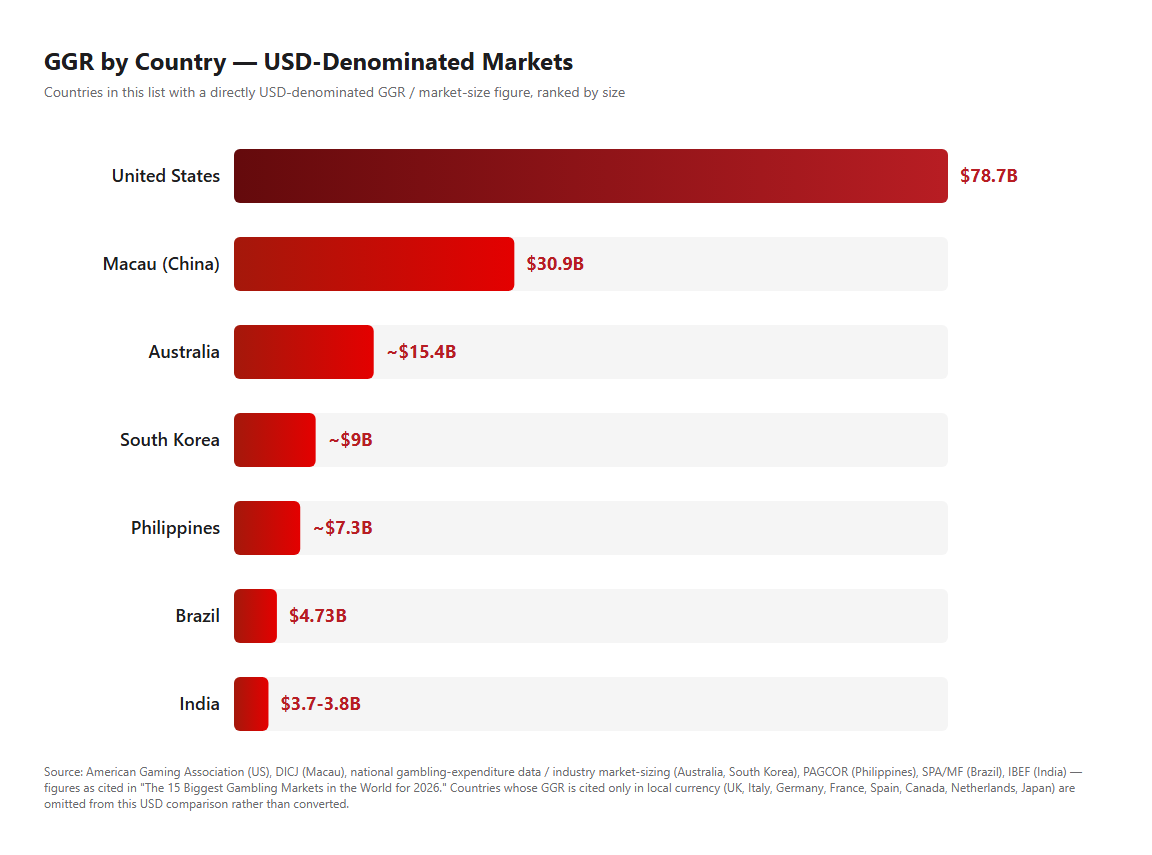
Rank a gambling market on more than GGR: here's what else counts
There's no single "correct" way to rank top gambling countries - a market with the highest total revenue (the United States) isn't necessarily the best gambling market by country for a media buyer targeting mobile-first igaming traffic (the Philippines or Brazil). We weighed multiple angles so this list works whether you're sizing the market overall or scouting where to run igaming traffic by geo.
- Gross gaming revenue (GGR): the core metric - actual money retained by operators after payouts, sourced from national regulators (UK Gambling Commission, ADM, ANJ, GGL, PAGCOR, DICJ) or named research firms (H2 Gambling Capital, Statista) wherever a government figure wasn't public.
- Online/igaming penetration: the share of GGR coming from online channels versus retail, since this determines how much of a market's spend is reachable through digital advertising versus in-person venues.
- Year-over-year growth rate: markets accelerating fastest (Brazil, the Philippines, India) often represent better forward-looking traffic opportunity than large-but-flat markets.
- Regulatory structure: whether the market is nationally regulated, state/province-regulated, or a hybrid, since this shapes how campaigns must be geo- and compliance-targeted.
- Market maturity and competitive density: how saturated the affiliate and advertiser landscape already is, which affects cost-per-click and traffic value.
- Population and mobile/internet penetration: the underlying addressable audience size behind the revenue figure.
- Named-source verifiability: most entries below cite a specific regulator or research firm; where only broader industry market-sizing data was available rather than a single named regulator (flagged inline for Australia and South Korea), that is disclosed rather than presented as an official figure.
Countries with the highest gambling GDP contribution and highest per-capita gambling spend both show up here, because both signal genuinely deep markets rather than one-off statistical spikes. This is gambling market size by country as it actually breaks down in named-source data, not a theoretical model - and it doubles as a map of the largest online gambling markets in the world, since online share is one of the six criteria above.
Promote casino & betting offers with TrafficSigma's fraud-filtered traffic!15 gambling countries: GGR, growth, and market structure compared
The TrafficSigma platform already runs igaming campaigns across 248+ GEOs, including all 15 markets below, so this ranking reflects where real advertiser demand and regulator data overlap - not just theoretical market size. Here's the full list before the detailed breakdown:
- United States
- Macau (China)
- Japan
- United Kingdom
- Italy
- Australia
- Germany
- Philippines
- Brazil
- France
- Spain
- Canada (Ontario)
- South Korea
- India (market-size data point; RMG now banned nationwide)
- Netherlands
Now let's review each of the biggest gambling markets in detail.
1. United States
The largest gambling market in the world by commercial GGR, and still growing. U.S. commercial gaming generated a record $78.7 billion in GGR in 2025, up 9.2% year-over-year, according to the American Gaming Association's Commercial Gaming Revenue Tracker - the industry's fifth consecutive record year. In-person casino revenue hit $51.7 billion, sports betting operators kept $16.9 billion of bets, and iGaming GGR reached $10 billion, with Michigan, New Jersey, and Pennsylvania leading the online segment.
Legal gambling in the U.S. is regulated state-by-state rather than federally, and the AGA counts 38 distinct commercial gaming markets across the country, each with its own licensing regime, tax rate, and product mix (some states allow full online casino, others only sports betting, some neither). That patchwork is the single biggest structural fact for anyone running U.S. igaming traffic: a campaign legal and scalable in New Jersey may be entirely unavailable in Texas.
For affiliates and media buyers, the U.S. combines the largest absolute spend pool with the most fragmented compliance map of any market on this list - which is exactly the kind of geo-by-geo complexity that rewards granular targeting over blanket national buys.
Highlights:
- Est. GGR: $78.7B (2025) - American Gaming Association
- Structure: State-by-state regulation, 38 commercial gaming markets
- Online share: iGaming GGR of $10B, sports betting GGR of $16.9B (2025)
- Growth: +9.2% YoY, fifth straight record year
- Best for: High-value, state-targeted igaming and sports betting campaigns
TrafficSigma's state-level GEO and carrier targeting lets advertisers isolate campaigns to exactly the U.S. states where online casino or sports betting is actually licensed, instead of wasting spend on impressions in states where the offer can't legally convert.
See our companion guide, Top 15 Gambling Affiliate Programs and Platforms for 2026, for a full breakdown of which affiliate programs pay the best CPA and RevShare terms for U.S. traffic specifically.
2. Macau (China)
Macau is the world's largest casino gambling hub by GGR, and the only part of Greater China where commercial gambling is legal - mainland China itself bans casino gambling outright, which is why Macau (a Special Administrative Region) carries this entry rather than "China." Macau's six licensed concessionaires posted GGR of MOP 247.4 billion (US$30.9 billion) in 2025, according to the Gaming Inspection and Coordination Bureau (DICJ) - up 9.1% year-on-year and the highest annual total since before the pandemic, at roughly 85% of 2019's pre-COVID peak.
Macau's market is almost entirely land-based, VIP- and premium-mass-driven, and structurally different from every other entry on this list: there is no meaningful licensed online igaming vertical, since online gambling is not permitted for the domestic Chinese market. The GGR figure is more than double the annual take of the entire Las Vegas Strip, concentrated in a handful of integrated resort operators rather than distributed across hundreds of licensees.
For advertisers, Macau itself is not a digital-traffic market in the way the rest of this list is - but the broader Greater China and Southeast Asian VIP-travel audience around it is a relevant targeting layer for premium-focused campaigns.
Highlights:
- Est. GGR: MOP 247.4B / US$30.9B (2025) - DICJ (Gaming Inspection and Coordination Bureau)
- Structure: Six licensed land-based concessionaires, no domestic online vertical
- Online share: Effectively 0% - land-based/VIP and premium-mass dominant
- Growth: +9.1% YoY (2025)
- Best for: Land-based/VIP casino context, not direct online-traffic targeting
3. Japan
Japan's pachinko and pachislot sector is one of the largest gambling-adjacent markets in the world by pure scale, even though it sits in a legal gray zone distinct from Western-style gambling. Industry estimates place the pachinko/pachislot market in the trillions of yen annually, and Statista's market tracking shows the sector as the dominant driver of Japan's broader amusement industry revenue.
Structurally, pachinko operates under a "three-shop system" workaround rather than direct cash payouts, since Japan's penal code technically prohibits gambling for money - players exchange winnings for prizes, which are then sold back for cash at a separate, nominally unconnected counter. Japan's only other legal gambling verticals are public-sector betting (horse racing, boat racing, bicycle racing) and, since 2018, a narrowly licensed integrated-resort casino framework that has moved slowly toward launch. Online casino and sports betting remain unregulated for domestic operators, meaning most digital gambling traffic touching Japanese players routes through offshore-licensed sites.
Given the legal gray zone around online formats, campaigns targeting Japan need conservative, compliance-aware creative rather than direct casino-brand messaging. Note that "trillions of yen" is a wide, unquantified range rather than a precise GGR figure, so Japan's position on this list reflects its overall scale and gambling-adjacent relevance rather than a like-for-like GGR comparison against the regulator-sourced figures elsewhere in this ranking.
Highlights:
- Est. market size: Trillions of yen annually (pachinko/pachislot) - Statista
- Structure: Prize-exchange "three-shop system," not direct-payout gambling
- Online share: No domestically licensed online casino/betting framework
- Growth: Long-run decline in parlor count; amusement-sector revenue still gambling-dominant
- Best for: Public-sector betting and adjacent amusement-vertical targeting
4. United Kingdom
The UK is the most mature, most transparently regulated gambling market in the world, and its regulator - the UK Gambling Commission - publishes some of the best public GGR data anywhere. British gross gambling yield hit £16.8 billion in the year to March 2025, up 7.3% year-on-year, according to the Gambling Commission's industry statistics; excluding lotteries, GGY was £12.6 billion, up 9.3%.
Online gambling is the UK's largest single channel: remote casino, betting, and bingo (RCBB) generated £7.8 billion of that total, up 13.1% year-on-year, and now represents 46% of total industry GGY versus 29% for land-based venues and 25% for licensed lotteries (including the National Lottery, which sold £7.9 billion in tickets). The UK's single-regulator, single-license national model - one Gambling Commission license covers the whole market - is the clearest contrast to the U.S.'s state-by-state patchwork.
That regulatory clarity is exactly why the UK remains one of the top igaming countries for affiliates: compliance requirements are well-documented, and the online channel's growth rate is outpacing the market overall.
Highlights:
- Est. GGR: £16.8B (FY to March 2025) - UK Gambling Commission
- Structure: Single national regulator (UKGC), one license covers all of Great Britain
- Online share: £7.8B / 46% of total GGY - largest single channel
- Growth: +7.3% YoY overall, +13.1% YoY online
- Best for: Compliance-mature online casino and sports betting campaigns
A related-post you may want next: Top 15 Gambling Affiliate Programs and Platforms for 2026 - a verified directory of CPA and RevShare terms, several of which are UK-licensed and built specifically for this kind of mature market. Continue reading for the full program comparison.
5. Italy
Italy is the largest fully-online-regulated gambling market in continental Europe by GGR. Total Italian gambling GGR reached €21.6 billion in 2024, with online channels contributing roughly €5 billion of that - an 11% year-on-year increase from €4.5 billion in 2023 - according to reporting on data from ADM (Agenzia delle Dogane e dei Monopoli), Italy's gambling regulator. Online betting alone (sports, virtual, horse racing) posted GGR of €1.843 billion, up 11%, on turnover that grew 12% to €16 billion.
Italy overhauled its online gambling licensing in late 2024: ADM's new nine-year concessions cost €7 million each plus an annual 3% GGR fee, and the licensing round alone generated €365 million in direct revenue for the regulator from 52 applications across 46 companies - comfortably beating the finance ministry's original target. Online gaming (casino, table games, bingo, poker) is projected to reach €3.2 billion in GGR in 2025, up 16%.
The new concession structure effectively resets the competitive field, which makes Italy one of the more interesting top igaming countries for affiliates and advertisers right now - new nine-year licensees are actively building audiences from scratch.
Highlights:
- Est. GGR: €21.6B total / ~€5B online (2024) - ADM (Agenzia delle Dogane e dei Monopoli)
- Structure: National licensing via ADM; new 9-year concession regime from Nov 2024
- Online share: ~23% of total GGR, growing faster than land-based
- Growth: +11% YoY online (2024); online gaming projected +16% in 2025
- Best for: Newly-licensed operators building audience under the 2024 concession reset
TrafficSigma's Italy-specific GEO and device targeting lets newly-licensed operators reach mobile-first Italian players from day one of their nine-year concession, without waiting to build organic reach.
6. Australia
Australia posts among the highest per-capita gambling losses of any major market in the world. Australians lost roughly AU$31.5 billion in the 2022-23 financial year on total wagers of AU$244.3 billion, and average annual losses per adult reached AU$1,555, up 11.5% year-on-year - figures compiled from national gambling-expenditure data cited across Australian regulatory and industry reporting; this remains the most recent official national compilation available, though it is now several years old. Separately, and not directly comparable to the losses figure above, the broader Australian gambling market is projected (per industry market-sizing data, not a named regulator) to generate roughly US$15.4 billion in revenue in 2025, with the online segment alone valued near US$5.2 billion in 2024.
Structurally, Australia regulates gambling at the state and territory level (similar in spirit to the U.S.), with poker machines ("pokies") outside casinos representing an unusually large share of losses compared to other developed markets, and online in-play sports betting under continued regulatory scrutiny federally. About 60.3% of Australian adults gambled in some form in 2024, down from 65.6% in 2019 - a participation dip that hasn't yet dented total losses.
That combination - high per-capita spend, falling participation, and rising average loss per gambler - signals a market where existing bettors are wagering more even as the overall base narrows, which matters for targeting depth over reach.
Highlights:
- Est. market size: ~US$15.4B (2025) - industry market-sizing data; AU$31.5B in losses (2022-23) - national gambling-expenditure statistics
- Structure: State/territory-regulated; pokies (EGMs) a uniquely large share of spend
- Online share: ~US$5.2B (2024), fastest-growing segment
- Growth: Per-adult losses +11.5% YoY even as participation rate declines
- Best for: High-value legal online sports and racing wagering campaigns - Australia's Interactive Gambling Act 2001 bans online casino games and poker outright for operators serving Australian customers
7. Germany
Germany's regulated gambling market has stabilized at its all-time high following the country's 2021 online-gambling reform. Total legal GGR held at €14.4 billion in 2024, a 5% expansion from the prior year, according to the GGL (Gemeinsame Glücksspielbehörde der Länder), Germany's joint state gambling regulator - with the 2025 activity report showing the market holding roughly steady at the same level.
Online gambling made up 24% of that total, or €3.5 billion, an 18% jump year-on-year, with online sports betting alone generating €1.3 billion (+10%) and virtual slots/online poker up a striking 38%. Gambling tax and levy revenue rose to around €7 billion in 2024. The GGL also estimates unlicensed/black-market GGR at €547 million, up 17% - though several licensed operators dispute that figure as too low, arguing the real offshore casino market alone may be several times larger.
The channelization gap - how much spend the regulated market is actually capturing versus offshore competitors - is the single most important structural fact for Germany: one recent estimate put the legal online channel's share of all German online gambling at around 77%, leaving a meaningful minority still reachable only through non-compliant channels advertisers should avoid.
Highlights:
- Est. GGR: €14.4B total / €3.5B online (2024) - GGL (Gemeinsame Glücksspielbehörde der Länder)
- Structure: Federal-state joint regulator (GGL) since 2021 reform
- Online share: 24% of total GGR, growing fastest in slots/poker (+38%)
- Growth: +5% YoY total, +18% YoY online
- Best for: Licensed online slots and sports betting campaigns competing against a shrinking black market
8. Philippines
The Philippines is one of the fastest-growing gambling markets in Asia, and increasingly a mobile-first one. The Philippine gaming industry's total GGR surged to PHP 410 billion (roughly US$7.3 billion) in 2024, a 25% jump from PHP 329 billion in 2023, according to PAGCOR (Philippine Amusement and Gaming Corporation) - with PAGCOR's own gross revenue reaching PHP 112 billion (US$1.92 billion), up 41%. The regulator's 2025 figures show a pullback from that peak: the industry posted PHP 396.14 billion in total GGR for the year, a decline of roughly 3.4% from 2024's PHP 410 billion, even as the domestic e-Games/e-Bingo segment kept expanding (see below).
The most important structural shift: e-Games and e-Bingo (the country's licensed domestic online/electronic gaming segment) grew 165% year-on-year in 2024 to PHP 154.5 billion, then grew a further 30% in 2025 to PHP 201.1 billion - now nearly half of total industry GGR and outgrowing traditional brick-and-mortar casino revenue. This coincided with the government's full ban on POGOs (Philippine Offshore Gaming Operators) completed in December 2024, a segment that had contributed just 3% of 2024 GGR before shutting down entirely.
That pivot - from offshore-facing POGO operations to domestic e-gaming growth - makes the Philippines one of the best countries for gambling traffic focused on mobile and electronic formats rather than legacy offshore models.
Highlights:
- Est. GGR: PHP 410B / ~US$7.3B (2024) - PAGCOR (Philippine Amusement and Gaming Corporation)
- Structure: PAGCOR-regulated; POGO offshore segment fully banned Dec 2024
- Online share: e-Games/e-Bingo at PHP 201.1B (2025), ~49% of total GGR
- Growth: +25% YoY total GGR (2024); total GGR then dipped ~3.4% in 2025 even as e-gaming grew +30% YoY
- Best for: Mobile-first e-gaming and e-bingo campaigns in a post-POGO domestic market
TrafficSigma's carrier-level targeting across Southeast Asia is built for exactly this kind of mobile-first e-gaming growth - reaching Filipino players on the networks and devices they actually use, at CPC rates starting from $0.006.
9. Brazil
Brazil is the newest large regulated gambling market in the world, having only formally launched licensed online sports betting and igaming ("Bets") on January 1, 2025, under Law No. 14,790/2023. The Brazilian government issued 68 operator licenses ahead of launch, each costing roughly BRL 30 million (~US$6.1 million) for five years' validity, regulated by the SPA/MF (Secretaria de Prêmios e Apostas, under the Ministry of Finance).
Early results have been dramatic: Brazil's regulated betting/igaming operators reported roughly US$4.73 billion in gross gaming revenue (GGR) - not tax collections - across just the first seven months of 2025, with July 2025 alone generating US$928 million in regulated GGR versus roughly US$8 million in July 2024, when the market was still unregulated and largely unreported. That jump reflects the shift to Brazil's first full year of mandatory regulated reporting rather than organic year-over-year growth within a like-for-like market. Operators pay a 12% tax on GGR, player winnings above BRL 2,824 face 15% income tax, and the law bans credit-funded bets and sign-up bonuses outright, alongside strict advertising limits.
Brazil's combination of a huge, mobile-first population and brand-new formal regulation makes it arguably the single fastest-growing entry on this list - but the strict ad and bonus restrictions mean campaigns here need to be built around the new rules from day one, not adapted from an unregulated-market playbook.
Highlights:
- Est. GGR: US$4.73B (first 7 months of 2025) - SPA/MF (Secretaria de Prêmios e Apostas)
- Structure: Newly regulated under Law 14,790/2023; 68 licensed operators from Jan 2025
- Online share: Effectively the entire regulated market - Brazil's framework is online-first
- Growth: July 2025 regulated GGR of ~US$928M vs. ~US$8M in the unregulated, unreported market of July 2024 - reflects the shift to mandatory reporting, not like-for-like YoY growth
- Best for: Ground-floor entry into a large, newly-legalized mobile betting market
10. France
France's gambling market is Western Europe's fourth-largest, anchored by state-linked lottery and horse-racing monopolies alongside a growing licensed online segment. Total French GGR reached €14.1 billion in 2025, up roughly 0.7% from €14 billion in 2024, according to the ANJ (Autorité Nationale des Jeux), France's national gambling regulator - with 2024's growth driven partly by an exceptional sports calendar spanning the UEFA Euro and the Paris Olympics.
FDJ United, which holds exclusive rights to France's lottery and retail sports betting, accounted for close to half the market at €6.95 billion in GGR in 2025 (+2.8%), while PMU, the horse-racing betting monopoly, saw GGR dip 2.8% to €1.65 billion even as its active player base grew to 3.5 million, the highest since before the pandemic. The fully-competitive online segment - where multiple licensed operators compete rather than a single monopoly - represented about 18.6% of the total market in 2024, with online sports betting GGR up 19% to €1.8 billion.
France's dual structure - state-linked monopolies for lottery/horse racing, open competition for online sports betting and poker - means campaign strategy has to be channel-specific: monopoly verticals aren't open to new entrants, but the online-competitive segment is growing faster than the market overall.
Highlights:
- Est. GGR: €14.1B (2025) - ANJ (Autorité Nationale des Jeux)
- Structure: FDJ (lottery/retail betting) and PMU (horse racing) monopolies plus open online licensing
- Online share: ~18.6% of total GGR, growing faster than the overall market
- Growth: +0.7% YoY (2025), +4.7% YoY (2024)
- Best for: Competitive online sports betting and poker campaigns outside the monopoly verticals
Get iGaming traffic from TrafficSigma now!
11. Spain
Spain's regulated online gambling market has posted double-digit growth for several consecutive years. Online GGR reached €1.454 billion in 2024, up 17.6% year-on-year, according to the DGOJ (Dirección General de Ordenación del Juego), Spain's national online-gambling regulator - with online sports betting the fastest-growing segment at 24% growth, contributing €609 million of the total. Momentum has continued into 2025 and 2026: Q3 2025 online GGR hit €405.4 million (+16.5% YoY), and Q1 2026 reached €454.1 million (+13.9% YoY).
Active registered player numbers grew 21.6% in 2024, reflecting genuine audience expansion rather than just higher spend per existing player. Spain's regulatory model centers on a single national online license administered by the DGOJ, distinct from land-based gambling, which is regulated separately at the regional (autonomous community) level - a two-tier structure advertisers need to account for when a campaign spans both online and land-based-linked promotions.
Consistent double-digit online growth across multiple consecutive quarters makes Spain one of the more dependable top igaming countries for affiliates seeking compounding, rather than one-off, traffic value.
Highlights:
- Est. GGR: €1.454B online (2024) - DGOJ (Dirección General de Ordenación del Juego)
- Structure: National online license (DGOJ); land-based regulated separately per region
- Online share: Online-only figure reported separately from land-based; sports betting is the largest online vertical
- Growth: +17.6% YoY (2024), +13.9% YoY most recent quarter (Q1 2026)
- Best for: Sustained-growth online sports betting and casino campaigns
12. Canada (Ontario)
Canada's provincially-regulated online gambling market is scaling quickly, led by Ontario's single-jurisdiction, multi-operator model. Ontario's regulated iGaming GGR reached CA$3.20 billion for the fiscal year to March 2025, up 32% year-on-year, according to AGCO (Alcohol and Gaming Commission of Ontario) and iGaming Ontario data - with casino gambling contributing CA$2.40 billion (+36%) and betting revenue up 23% to CA$724 million. On a calendar-year basis, Ontario operators handled roughly CA$98.3 billion in total wagers in 2025 and generated CA$4 billion in gross gaming revenue, up 34% year-on-year.
Ontario remains the only Canadian province with an open, competitive private-operator iGaming market; other provinces run government-operated online platforms instead. A joint AGCO/iGaming Ontario study found 83.7% of surveyed Ontario players used a regulated site, suggesting the province's open-license model is successfully channelizing play away from offshore operators. Canada's total online gambling market is projected to reach roughly CAD 5.55 billion in 2025 across all provinces combined.
For advertisers, Ontario functions almost like its own regulated country within Canada - the rest of the country's provinces are a mix of provincial-monopoly and unregulated-adjacent markets, so campaign structures that work in Ontario often need a completely different compliance approach elsewhere in Canada.
Highlights:
- Est. GGR: CA$3.20B (FY to March 2025, Ontario only) - AGCO / iGaming Ontario
- Structure: Ontario = open multi-operator private license model; other provinces = government-run platforms
- Online share: Ontario's model is 100% online/iGaming by definition
- Growth: +32% YoY GGR, +34% YoY calendar-2025 GGR
- Best for: Multi-operator competitive campaigns specifically within Ontario's licensed market
13. South Korea
South Korea runs one of the most tightly restricted gambling markets among major economies, which paradoxically makes its licensed venues extremely concentrated and lucrative. Kangwon Land - the only casino in the country legally permitted to admit South Korean citizens - generated roughly KRW 1.22 trillion in revenue, according to Statista, while the country's sixteen other casinos are foreign-nationals-only and collectively accounted for about 57% of total industry GGR. South Korea's broader online gambling market (largely public-sector lottery, horse racing, and sports-toto products, since private online casino and betting are illegal for residents) was valued at roughly US$9 billion in 2024.
The core structural fact for this market: South Korea bans its own citizens from casino gambling almost everywhere except the single Kangwon Land property, a policy aimed at limiting domestic gambling harm while still capturing foreign-tourist casino spend at the other 16 venues. Legal domestic betting is largely confined to public operators - horse racing (dating back to 1922), boat racing, cycling, and the state sports-toto lottery.
That legal structure means South Korea is a market where compliance nuance matters more than raw size: campaigns must clearly distinguish foreign-tourist-facing casino promotion from anything resembling resident-facing online betting, which remains illegal.
Highlights:
- Est. market size: ~US$9B online/public-betting segment (2024) - industry market-sizing data; KRW 1.22T at Kangwon Land alone - Statista
- Structure: Citizens barred from all but one casino; 16 others foreign-nationals-only
- Online share: Private online casino/betting illegal for residents; public lottery/racing only
- Growth: Foreign-only casinos ~57% of total GGR
- Best for: Foreign-tourist casino marketing and public-sector betting-adjacent campaigns only
14. India
India was, until recently, one of the largest mobile-driven real-money gaming (RMG) markets in the world by participation. India's overall online gaming sector was valued at roughly US$3.7-3.8 billion in 2024, up 23% year-on-year, according to IBEF (India Brand Equity Foundation) reporting - with real-money gaming making up 85.7% of that total at around US$3.2 billion, and more than 155 million Indians participating in real-money formats during the year. That figure is now a historical market-size data point rather than a live targeting opportunity: the national Promotion and Regulation of Online Gaming Act, 2025 (presidential assent August 2025, implementing rules notified April 2026) has since prohibited real-money online gaming nationwide, including its advertising and payment processing.
Before the nationwide ban, the market had already taken a hit from a 28% Goods and Services Tax (GST) applied to gaming deposits rather than revenue, which reduced major platforms' topline by an estimated 20%. India's online gamer base overall - across both real-money and non-real-money formats - had expanded to roughly 488 million people in 2024, according to a FICCI-EY report.
India's inclusion here is as a market-size data point, not a targeting recommendation: real-money gaming is no longer a legal advertising category in India. See our companion guide on where online gambling is legal by country for the current status of India's ban.
Highlights:
- Est. market size (2024, pre-ban): US$3.7-3.8B online gaming - IBEF; ~US$3.2B real-money gaming specifically
- Structure: Real-money online gaming now banned nationwide under the Promotion and Regulation of Online Gaming Act, 2025
- Online share: RMG was ~86% of the online gaming segment by revenue prior to the ban
- Growth: +23% YoY (2024, pre-ban) despite GST headwinds; overall online gamer base ~488M
- Best for: Market-size context only - real-money gaming is not a legal advertising target in India following the 2025 Act
15. Netherlands
The Netherlands offers a cautionary structural case study: a maturing online market currently losing ground to unlicensed operators after a round of tightened regulation. Dutch licensed online GGR (KOA - Kansspelen op Afstand) settled at roughly €1.2 billion on an annualized basis into 2025, with H1 2025 GGR of €600 million down 16% from H2 2024 and down 18.5% year-on-year, according to data from the Kansspelautoriteit (KSA), the Dutch gambling regulator.
The KSA's own channelization data is the key figure here: the share of Dutch online gambling spend flowing through licensed operators fell from 51% at the end of 2024 to 49% in the first half of 2025 - meaning slightly more than half of all Dutch online gambling spend now goes to illegal, unlicensed operators. The regulator attributes the decline partly to its own tightened rules: a gambling tax increase from 30.5% to 34.2% in January 2025 (rising further to 37.8% in 2026), plus mandatory monthly net deposit limits of €700 for adults and €300 for players aged 18-24.
The Netherlands is the clearest example on this list of how tax and deposit-limit policy can directly shrink a licensed market's channelization - a dynamic worth watching for any market considering similarly aggressive tightening.
Highlights:
- Est. GGR: ~€1.2B annualized online GGR (2025) - Kansspelautoriteit (KSA)
- Structure: Single national KOA online license; land-based regulated separately
- Online share: Channelization to licensed operators fell to 49% (H1 2025)
- Growth: -18.5% YoY online GGR (H1 2025) amid tax hikes and deposit limits
- Best for: Licensed-operator campaigns competing directly against a large offshore segment
Create Ads with TrafficSigma today!
GGR, online share, and growth rate for each of the 15 markets
Market sizes and structures can look similar from a distance, but GGR scale, online share, and regulatory model differ enormously country to country. This table lines up every entry above side by side, using the exact figures already cited in each entry.
| # | Country | Est. GGR / market size | Regulator / source | Online share | YoY growth | Best for |
|---|---|---|---|---|---|---|
| 1 | United States | $78.7B (2025) | American Gaming Association | iGaming $10B, betting $16.9B | +9.2% | State-targeted igaming/betting |
| 2 | Macau (China) | US$30.9B (2025) | DICJ | ~0% (land-based only) | +9.1% | Land-based/VIP casino context |
| 3 | Japan | Trillions of yen (pachinko) | Statista | No licensed online vertical | Long-run decline | Public-sector betting only |
| 4 | United Kingdom | £16.8B (FY Mar 2025) | UK Gambling Commission | 46% (£7.8B) | +7.3% (+13.1% online) | Mature online casino/betting |
| 5 | Italy | €21.6B total / ~€5B online (2024) | ADM | ~23% | +11% online | New 9-year concession entrants |
| 6 | Australia | ~US$15.4B (2025) | National gambling-expenditure data | ~US$5.2B online (2024) | +11.5% per-adult losses | High-value sports betting/pokies |
| 7 | Germany | €14.4B total / €3.5B online (2024) | GGL | 24% | +5% (+18% online) | Licensed slots/betting vs. black market |
| 8 | Philippines | PHP 410B / ~US$7.3B (2024) | PAGCOR | ~49% (e-Games/e-Bingo) | +25% (+30% e-gaming) | Mobile-first e-gaming |
| 9 | Brazil | US$4.73B (7mo 2025) | SPA/MF | ~100% (online-first framework) | From ~$8M to $928M/mo | Ground-floor newly-legal betting |
| 10 | France | €14.1B (2025) | ANJ | ~18.6% | +0.7% | Competitive online betting/poker |
| 11 | Spain | €1.454B online (2024) | DGOJ | Online reported separately | +17.6% | Sustained-growth online betting |
| 12 | Canada (Ontario) | CA$3.20B (FY Mar 2025) | AGCO / iGaming Ontario | 100% (iGaming-only figure) | +32% | Multi-operator Ontario campaigns |
| 13 | South Korea | ~US$9B online/public segment | Statista / industry data | Public lottery/racing only | Foreign casinos ~57% of GGR | Foreign-tourist casino marketing |
| 14 | India | US$3.7-3.8B (2024, pre-ban) | IBEF | ~86% was real-money gaming | +23% (2024, pre-ban) | Market-size context only - RMG now banned nationwide |
| 15 | Netherlands | ~€1.2B annualized online | Kansspelautoriteit (KSA) | 49% channelization | -18.5% online (H1 2025) | Licensed-operator competitive plays |
Turning this ranking into a targeting decision
The biggest gambling countries in the world span three very different situations: mature, high-GGR markets like the U.S. and UK where the challenge is precision targeting inside a complex compliance map; fast-emerging markets like Brazil and the Philippines where growth rate matters more than current absolute size; markets like India that have moved from rapid growth to national prohibition, underscoring how quickly a market's targetability can change; and cautionary markets like the Netherlands where aggressive tax and deposit-limit policy is actively shrinking licensed-channel share. Whichever type of gambling market by country you're prioritizing, the decision factors that matter most are the same three from our methodology: real regulator-sourced GGR, the online share of that GGR, and the year-over-year growth trend.
Sizing the market is only the first step - actually reaching players in any of these 15 markets means running igaming traffic by geo with targeting precise enough to respect each country's licensing lines, whether that's U.S. state boundaries, Brazil's new advertising restrictions, or excluding markets like India where real-money gaming is now nationally prohibited entirely. TrafficSigma's 248+ GEO network with granular GEO, device, OS, and carrier targeting is built specifically for that kind of country-by-country precision, so the same campaign infrastructure that works in a mature market like the UK can be reconfigured instantly for a ground-floor market like Brazil.
Start scaling your campaigns with TrafficSigma.