
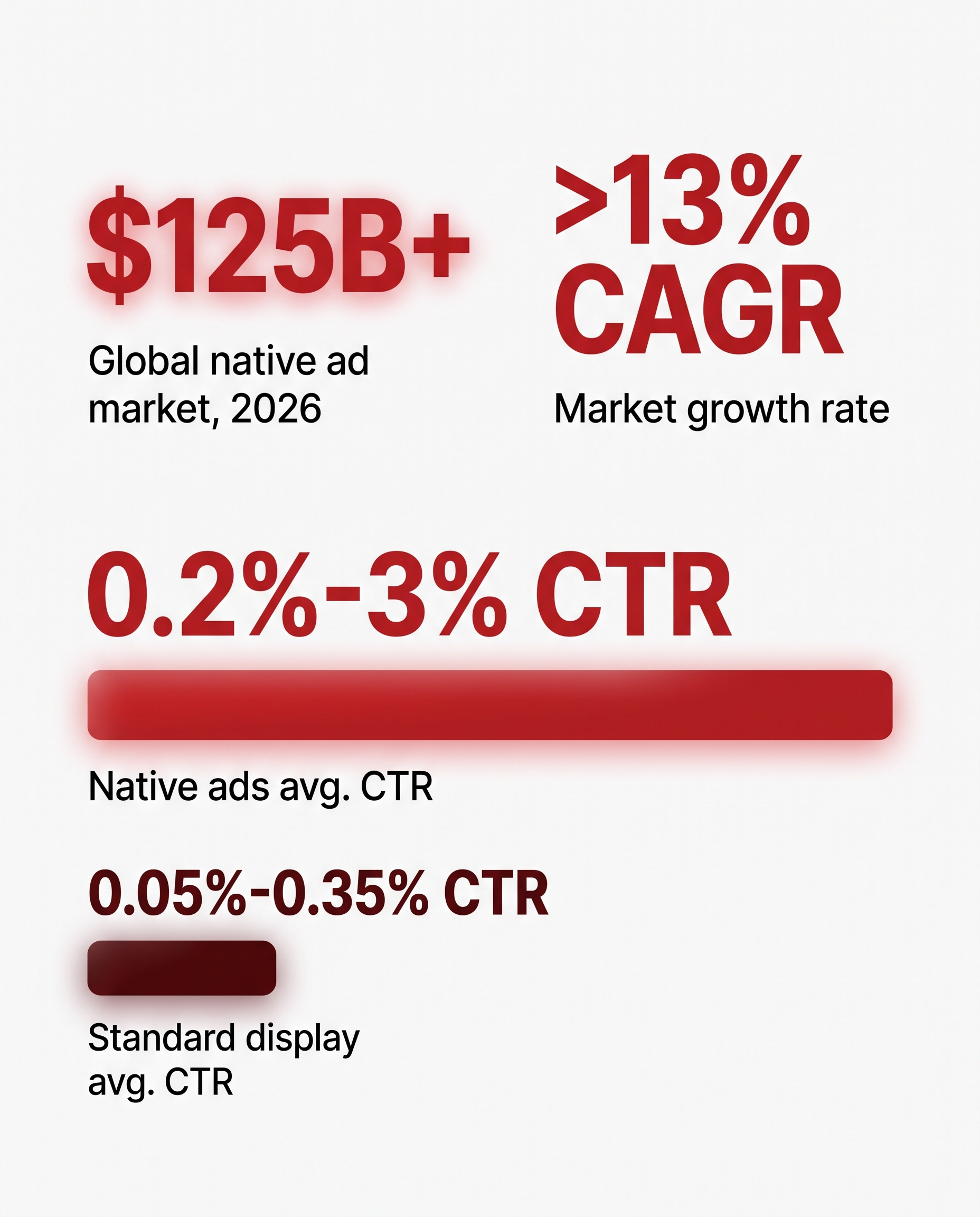
Market-size estimates for global native advertising vary widely by research firm - Mordor Intelligence puts the market at roughly $165.68 billion with a 12.73% CAGR, while other forecasts cite figures closer to $125 billion with growth north of 13% - so treat any single headline number as one estimate among several rather than a settled figure. What's consistent across forecasts is the direction: publishers and advertisers keep shifting budget away from formats readers have learned to ignore. That growth is a direct response to banner blindness: native ads regularly post average click-through rates in the 0.2%-3% range - at the upper end of that range, up to roughly 8-9x higher than the 0.05%-0.35% typical of standard display banners, though at the lower end the gap is closer to 4x - because they're built to look like the content around them instead of interrupting it.
The TrafficSigma team runs native traffic across 248+ GEOs every day, and this guide breaks down exactly what native advertising is, where native ads actually appear, why performance marketers and affiliates lean on native for compliance-sensitive verticals, how to build creative that gets approved and clicked, and how to choose a native ad network that fits your campaign.
What is native advertising?
Native advertising is paid content - an article, image, or video promotion - styled to match the look, feel, and placement of the platform it runs on, so it reads as part of the user experience rather than an interruption of it. A native ad on a news site looks like a recommended article; a native ad in a social feed looks like a regular post; a native ad in an app looks like in-app content. The paid nature is disclosed (typically with an "Ad" or "Sponsored" label), but the format itself doesn't visually fight the surrounding page.
That's the core distinction that separates native from the other formats in a performance marketer's toolkit, and it's worth being precise about the differences, since "native," "display," "push," and "pop" get used loosely and interchangeably in the industry:
- Native vs. display: Display ads are a distinct visual unit - a banner, a rectangle, a skyscraper - dropped into a page layout with its own border, background, and creative that looks nothing like the editorial content around it. Native ads inherit the page's fonts, image cropping, and card layout, so the ad and the content are visually continuous. This is the single biggest reason native consistently posts a higher CTR than banner display: the ad doesn't trigger the reader's learned instinct to scroll past anything that looks like an ad.
- Native vs. push notifications: Push ads are OS- or browser-level notifications that reach a user's device even when they aren't on a website - a subscriber opted in once, and every push after that is a direct, immediate ping. Push wins on immediacy and can post strong CTRs for well-targeted campaigns, sometimes reaching into the double digits, but reported figures vary widely by source and it depends entirely on a pre-existing opt-in base. Native has no opt-in requirement; it runs to any visitor a publisher's recommendation widget or in-feed slot serves, which makes it the better tool for reaching net-new audiences rather than re-engaging an existing list.
- Native vs. pop/popunder: Pop and popunder ads open a full separate browser tab or window, interrupting the session entirely to force a view. They're built for volume and low CPMs, not blending in. Native trades that raw volume for context: the ad appears next to content the reader already chose to read, which is why native performs better on trust-sensitive offers where an intrusive pop-under can hurt conversion.
In short: native earns attention by not looking like an ad; push earns attention by reaching an opted-in device directly; pop and popunder earn attention by forcing a view. Most experienced media buyers run more than one of these formats in the same account and route budget to whichever wins for a given offer and GEO.
Where native ads appear
Native ad units aren't one single placement - they show up across three distinct surfaces, and each has its own conventions worth knowing before you build creative:
- In-feed native ads: These sit directly inside a content feed - a social media timeline, a news app's article list, an e-commerce product grid - formatted to match the posts or listings around them. The ad occupies the same card shape, image ratio, and typography as organic content, with only a small "Sponsored" or "Ad" tag distinguishing it. In-feed is the dominant native surface on mobile, where feed-based browsing is the default reading pattern.
- In-content native ads: These are embedded inside the body of an article or piece of content itself - a paragraph-style sponsored insert, an in-article recommendation block, or a native video that plays mid-scroll. Because the reader is already several paragraphs into engaged reading, in-content native tends to carry higher dwell time than a feed placement, at the cost of lower overall volume (fewer available slots per page).
- Recommendation widgets: The "you might also like" or "around the web" module at the bottom (or side) of an article - the placement most people associate with the term "native ads" first, popularized at scale by networks like Taboola and Outbrain (now operating as Teads). These widgets mix genuinely organic recommended articles with paid placements in the same grid of thumbnail + headline, and they're the highest-volume native inventory type because nearly every content publisher runs one.
Each surface rewards slightly different creative: in-feed rewards native ads examples that mimic the platform's native post style almost exactly (a casino bonus offer styled like a social post performs better than one styled like a banner); recommendation widgets reward a strong curiosity-driven headline and thumbnail since the format is inherently a scroll-past decision made in under a second; in-content rewards a genuinely useful angle since the reader is already committed to reading. Looking at native advertising examples across verticals, the pattern holds regardless of category: the winning creative is the one that's hardest to distinguish from the organic post or article next to it.
Most media buyers don't build this inventory themselves - they buy native ads traffic through a self-serve network that already has publisher relationships and recommendation-widget placements live across hundreds of sites and apps. That's the fastest way to get a native campaign in front of real, GEO-targeted audiences without negotiating placements site-by-site.
Why performance marketers and affiliates use native ads
Native advertising for affiliate marketing has grown into one of the default traffic sources for a specific reason: it performs unusually well in verticals where a heavy-handed, obviously-commercial ad format either gets rejected by ad review, ignored by the reader, or both. Three mechanics explain why:
It clears ad review more reliably in regulated and semi-regulated verticals. iGaming, Finance/Forex, Nutra, and Sweepstakes offers frequently get rejected or restricted on ad platforms that apply strict creative policies to those categories. Native ad networks built around content recommendation are generally more accommodating of these "soft" or high-payout verticals than search or social platforms with blanket vertical bans, provided the required "Ad"/"Sponsored" disclosure is present and the landing page matches the promise of the creative.
It builds trust before the click, not just after it. A reader who clicks a native ad styled as a recommended article arrives with a warmer frame of mind than one who clicked an obviously commercial banner - they were reading content, and the ad extended that experience rather than breaking it. For compliance-sensitive offers (a casino bonus, a forex platform, a subscription trial), that softer frame reduces bounce and improves the odds the visitor actually reads the offer instead of reflexively closing the tab.
It scales across GEOs where regulatory posture varies. A native campaign promoting an iGaming offer can run in a Tier-1 GEO with strict advertising standards using compliant, responsible-gambling-aware creative, and the same network can run a more aggressive angle in a Tier-2 or Tier-3 GEO with lighter restrictions - without changing ad format. That flexibility is harder to replicate on platforms with a single global policy applied uniformly.
None of this means native is a way to sidestep licensing or disclosure requirements. The FTC's native advertising guidance is explicit: native units must be clearly and conspicuously labeled as commercial content (terms like "Ad," "Advertisement," or "Sponsored" satisfy this), and vaguer terms are a documented risk area - the more a native ad resembles the platform's organic content, the more prominent that disclosure needs to be. Compliant affiliates treat native as a distribution format, not a workaround - the offer itself still needs to meet the GEO's actual advertising and licensing rules.
Get pop/popunder traffic from $1.00 CPM with TrafficSigma!Native ad creative best practices
A native ad's entire job is to earn a click without looking like it's trying to. That means the creative rules are different from a banner or a push notification:
- Headline length and framing: Headline caps vary by network - Outbrain, for example, allows up to 100 characters but recommends around 60 for best rendering and performance - so check your target network's own spec rather than assuming a fixed limit, and note that shorter (roughly 6-10 words) headlines generally convert better across networks. Curiosity, a concrete number, or a direct benefit outperforms generic brand-first copy - "5 signs you're overpaying for car insurance" beats "Compare car insurance with [Brand]."
- Image selection: Requirements vary by network - Outbrain, for example, recommends 1200x800px for standard placements, with a 300px minimum applying specifically to 1:1 carousel-crop images rather than the format broadly - so confirm your target network's exact spec rather than assuming one universal size. Images featuring a real person's face or an authentic-feeling "in the wild" photo consistently outperform product shots or stock-looking graphics - the image needs to look like it belongs in a content feed, not an ad slot.
- Disclosure placement: Every native unit needs an "Ad" or "Sponsored" label placed clearly and conspicuously near the headline or thumbnail - this isn't optional creative polish, it's the FTC-mandated disclosure that keeps the format legal. Build it into your creative review checklist the same way you'd check image dimensions.
- Landing page continuity: The landing page has to deliver on exactly what the headline promised. A native ad that curiosity-gaps its way to a click but lands on an unrelated offer page gets flagged by the network's quality algorithms and tanks approval rates on future campaigns - native platforms actively penalize creative-to-landing-page mismatch because it's the fastest way to erode reader trust in their recommendation widgets.
- Angle testing at volume: Because native inventory is cheap relative to search or social, the standard workflow is to launch 5-10 headline/image variants per offer simultaneously, kill anything underperforming within the first few hundred clicks, and scale the 1-2 winners. Native rewards this kind of rapid iteration far more than formats with slower, more expensive testing cycles.
Choosing a native ad network
Picking among native ad networks comes down to matching a platform's actual strengths to your offer, vertical, and GEOs - not just picking whichever name is most recognizable. A few things worth checking before you commit budget:
- Vertical acceptance policy: Does the network explicitly support your vertical (iGaming, Finance/Forex, Nutra, Sweepstakes, Dating) or restrict it? The largest recommendation-widget networks skew toward mainstream consumer categories and apply stricter review to high-payout verticals; platforms built specifically around performance-marketing traffic tend to have clearer, published policies for these categories instead of a case-by-case guess.
- GEO coverage and targeting granularity: A network with broad country coverage is only useful if its targeting is actually granular - GEO down to city or region, device type, OS version, and (for mobile-heavy verticals) carrier. Coarse "country-only" targeting wastes spend in campaigns where a specific device/OS/carrier combination converts very differently from the GEO average.
- Minimum spend and self-serve access: Some legacy native networks still gate access behind an account manager and a minimum monthly commitment. A self-serve dashboard where you can launch, monitor, and adjust campaigns directly - without waiting on a rep - matters most to affiliates and media buyers running multiple small tests before scaling a winner.
- Bidding and optimization tools: Look for Micro Bidding (adjusting bids at a granular GEO/device/source level rather than one flat bid for the whole campaign), Target CPA optimization, and an automated Performance Mode that reallocates spend toward converting sources mid-flight. These tools are what separate a network you can actually scale profitably from one that requires constant manual bid-tweaking.
- Fraud protection: Native inventory, like any programmatic format, carries bot and fraud risk from low-quality sources. Multi-layer fraud filtering (source-level vetting, in-flight traffic-quality scoring, and post-click validation) protects your spend from inflated impression and click counts that never had a chance to convert.
TrafficSigma's native ad format runs across the same 248+ GEO footprint as the platform's push, pop, and Telegram Mini App inventory, with the same granular GEO/device/OS/carrier targeting, Micro Bidding, Target CPA, and Performance Mode optimization tools available on native campaigns as on every other format - plus the 3-level fraud protection and vetted premium source pool the network applies platform-wide. For iGaming, Finance/Forex, Nutra, Dating, and Sweepstakes advertisers specifically, that means one self-serve account can run a native campaign next to a push or popunder campaign for the same offer, compare performance directly, and shift budget toward whichever format is actually converting in a given GEO - without renegotiating terms with a second vendor.
Get iGaming traffic from TrafficSigma now!
A native placement and network built to convert, not just blend in
Native advertising wins on a simple mechanic: it looks like content, not an interruption, which is why it consistently outperforms banner display on CTR and clears review more reliably than obviously commercial formats in regulated and semi-regulated verticals. The decisions that actually determine whether a native campaign works are the same three this guide covered - picking the right placement type (in-feed, in-content, or recommendation widget) for your offer, building creative that respects both the platform's disclosure rules and its "looks native" requirement, and choosing a network whose vertical policy, GEO targeting, and optimization tools actually fit a performance-marketing account rather than a mainstream-brand one.
The fastest way to test all of that is inside a single self-serve account rather than juggling separate vendor relationships for every format. TrafficSigma runs native alongside push, pop/popunder, domain redirect, and Telegram Mini App traffic across 248+ GEOs, so a native campaign for an iGaming, Finance/Forex, Nutra, Dating, or Sweepstakes offer can be launched, measured, and optimized right next to every other format you're already running - with the same Micro Bidding, Target CPA, and Performance Mode tools, and the same fraud protection, applied consistently across all of them.