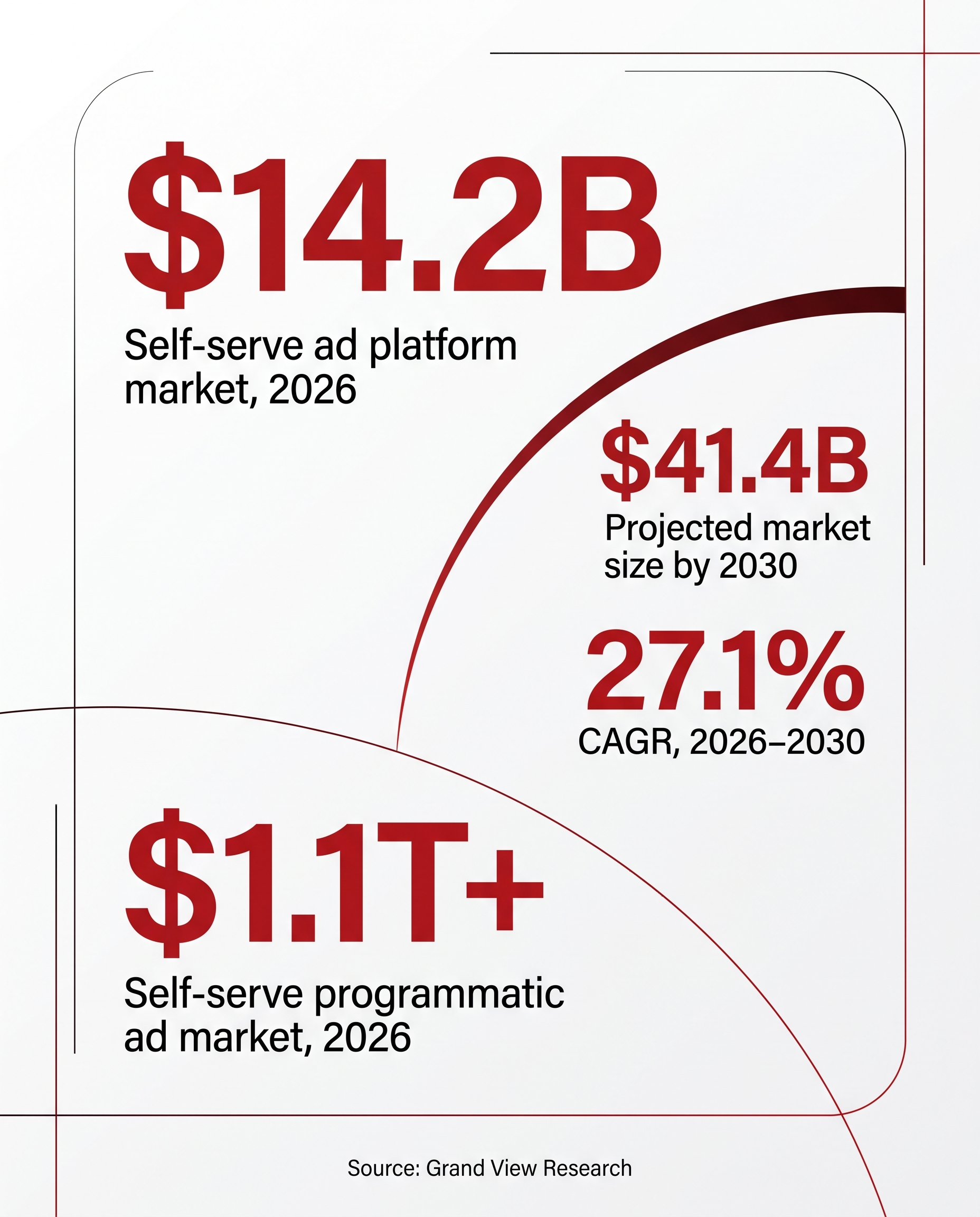
Grand View Research's Programmatic Advertising Platform Market report puts that market (a broader category than "self-serve" specifically, since it includes managed and hybrid buying alongside self-serve) at roughly $14.2 billion in 2026, growing at a 27.1% CAGR to $41.4 billion by 2030 - Grand View Research does not publish a market sized specifically as "self-serve advertising," so treat this as the closest available proxy rather than a direct figure for the self-serve segment alone.
More advertisers are moving away from managed-service ad reps toward direct campaign control, using self-serve ad tools to bid, target, and optimize themselves instead. That shift matters most for affiliates and media buyers running push, pop, native, and Telegram traffic, where margins are won or lost in the bid, the GEO, and the fraud filter - not in a slow email thread with an account manager.The TrafficSigma team tested, compared, and ranked the self-serve advertising technology affiliates actually use in 2026 - pulling real minimum deposits, real CPC/CPM floors, and real format coverage instead of marketing copy. Below are the 10 self-serve ad platforms and self-serve ad marketplaces worth your budget this year, including where TrafficSigma itself fits for push, pop, and Telegram Mini App traffic specifically.
Self-serve platforms live or die on these seven criteria
There's no single "best" self-serve platform for every buyer - a push-and-pop affiliate running iGaming offers needs something very different from a brand running native content discovery. Instead of a generic scorecard, we compared each self serve ad network against the criteria that actually decide whether a self-serve advertising platform is usable at real budget:
- Self-serve depth: how much of the platform is genuinely self-service - real-time dashboard, campaign builder, and bid controls with no forced account-manager gatekeeping - versus a "self-serve" label bolted onto what's really a managed sales process.
- Pricing floor and model: the actual minimum CPC/CPM published for the platform's core format, and whether it offers CPC, CPM, SmartCPM/auto-bid, or CPA Goal pricing.
- Minimum deposit: the real dollar figure needed to open a self-serve advertiser account and start spending, since this determines how accessible the self serve advertising technology is to smaller media buyers.
- GEO and format coverage: how many countries the network delivers into and how many traffic formats (push, pop, native, in-page push, domain redirect, Telegram) it supports natively, since format breadth is what lets one dashboard replace three vendor relationships.
- Targeting and optimization tools: the granularity of GEO/device/OS/carrier targeting and whether the platform offers automated bid optimization (micro-bidding, target CPA, smart algorithms) rather than flat manual bidding only.
- Fraud protection: whether the network runs its own bot/fraud filtering on traffic sources, since self serve ad marketplaces without this are a direct threat to ROI at scale.
- Vertical fit for affiliates: whether the platform actively supports high-payout verticals (iGaming, Finance/Forex, Nutra, dating, sweepstakes) rather than restricting or deprioritizing them.
This section is the reason the list below isn't a rehash of generic "top ad networks" content - every entry was checked against the same seven criteria.
Get iGaming traffic from TrafficSigma now!
Which 10 self-serve platforms earn their place on pricing and depth?
The TrafficSigma team runs and buys traffic across this exact competitive set daily - 248+ GEOs, five traffic formats, and a self-serve dashboard built specifically for affiliates, which is why we know this landscape from the buying side, not just from reading other people's reviews. Here is the full list before the detailed breakdown:
- TrafficSigma
- RichAds
- PropellerAds
- Adsterra
- Adcash
- HilltopAds
- Zeropark
- RollerAds
- MGID
- Taboola
Now let's review each self-serve ad platform in detail.
1. TrafficSigma
TrafficSigma is a global self-serve ad network built specifically for performance marketers running iGaming, Finance/Forex, Nutra, dating, sweepstakes, and other high-payout verticals, with full self-serve dashboard access from account creation - no forced managed-service gate. It's one of the few self serve ad networks for affiliates that natively covers Telegram Mini App ads alongside the more established push and pop formats in a single interface.
Push and Telegram ads start from $0.006 CPC and pop/popunder traffic starts from $1.00 CPM, with delivery across 248+ GEOs and granular GEO, device, OS, and carrier targeting. The platform runs on 5B+ daily push and Telegram impressions, 4B+ daily pop impressions, and 1B+ daily domain-redirect impressions, and layers in Micro Bidding, Target CPA, and Performance Mode for automated bid optimization rather than flat manual bidding only.
Campaigns are backed by 3-level fraud protection and vetted premium sources, which matters most in exactly the verticals TrafficSigma leans into - iGaming and Finance/Forex traffic gets hit hardest by bot and click-fraud activity industry-wide, so filtering at the source level rather than after the click protects budget instead of just reporting on waste after it's spent. For affiliates already running push, pop, or Telegram traffic, consolidating into one self-serve ad marketplace with this much format breadth cuts the vendor-management overhead of running three separate dashboards.
Highlights:
- Type/Category: Multi-format self-serve ad network (push, in-page push, pop/popunder, domain redirect, native, Telegram Mini App, calendar push)
- Terms/Pricing: Push/Telegram from $0.006 CPC; pop/popunder from $1.00 CPM
- Cadence/Frequency: Self-serve, always-on campaign launch
- Requirements/Minimum: Self-serve account, no forced managed minimum
2. RichAds
RichAds is a self-serve ad network built for affiliate marketers, founded in 2018 and headquartered in Limassol, Cyprus, offering eight traffic formats from a single self-serve dashboard. It positions itself around AI-driven bid and targeting optimization layered on top of manual self-serve controls.
The platform's self-serve minimum deposit is $150, with push ads starting from $0.005 CPC (RichAds' published minimum for push), native ads from $0.001 CPC, pop traffic from $0.5 CPM, domain ads from $1.5 CPM, and Telegram ads from $0.015 CPC. RichAds self-reports several billion daily impressions across 200+ GEOs and integrates with a range of third-party trackers (unverified exact counts - confirm current specifics on RichAds' own site), which matters for affiliates who already run a fixed attribution stack and don't want to switch tools to onboard a new traffic source.
RichAds layers AI-based bid, targeting, and fraud-prevention automation on top of its self-serve dashboard, and pairs the self-service tier with account-manager support for advertisers who deposit $500 or more.
Highlights:
- Type/Category: Multi-format self-serve network (push, pop, native, domain redirect, Telegram, calendar)
- Terms/Pricing: Push from $0.005 CPC; native from $0.001 CPC; pop from $0.5 CPM
- Cadence/Frequency: Self-serve, always-on campaign launch
- Requirements/Minimum: $150 minimum deposit
3. PropellerAds
PropellerAds is a multisource self-serve advertising platform founded in 2011 and headquartered in Limassol, Cyprus, used by more than 50,000 active advertisers according to the company's own published figures. It covers popunder, push, in-page push, interstitial, and native formats from one self-service dashboard.
Self-serve minimum deposit sits at $100 for card payments ($1,000 for wire transfer), with push CPC starting from roughly $0.005 depending on GEO and format. PropellerAds spans 195+ GEOs and claims up to 15 billion daily ad impressions, and its self-serve system offers CPM, CPC, SmartCPM (automated bidding), and CPA Goal 2.0 pricing models rather than flat manual bidding only.
The SmartCPM option auto-sets bids based on the advertiser's targeting, which reduces the manual bid-tuning workload for affiliates running large GEO/device-targeting matrices across dozens of campaigns at once.
Highlights:
- Type/Category: Multi-format self-serve network (popunder, push, in-page push, interstitial, native)
- Terms/Pricing: Push from ~$0.005 CPC; CPM/SmartCPM/CPA Goal 2.0 available
- Cadence/Frequency: Self-serve, always-on campaign launch
- Requirements/Minimum: $100 minimum deposit (card)
4. Adsterra
Adsterra is a self-serve advertising network and SSP launched in 2013, delivering into 248 GEOs with more than 35 billion monthly ad impressions by the company's own reporting. Its self-serve platform is built around its Social Bar and in-page push formats alongside standard popunder, native, and banner inventory.
Self-serve minimum deposit is $100 via card, $200 via crypto, or $1,000 via wire transfer, and Adsterra sets a minimum total/daily campaign budget of $25 on CPM and CPC pricing models. The platform's Traffic Estimator tool recommends competitive CPM, SmartCPM, and CPC rates per GEO before launch, which shortens the trial-and-error bidding cycle for affiliates testing a new country.
Adsterra's CPA pricing option on top of CPM/CPC gives performance-focused affiliates a way to pay only for validated conversions rather than raw impressions or clicks, which is a meaningful difference from platforms that only price on traffic delivered.
Highlights:
- Type/Category: Multi-format self-serve network (Social Bar, in-page push, popunder, native, banner)
- Terms/Pricing: $25 minimum CPM/CPC campaign budget; CPA available
- Cadence/Frequency: Self-serve, always-on campaign launch
- Requirements/Minimum: $100 minimum deposit (card)
5. Adcash
Adcash is a self-serve DSP founded in 2007 and headquartered in Tallinn, Estonia, making it one of the longer-running self serve ad networks still actively used by affiliates. The self-serve platform covers popunder, native, banner, autotag, interstitial, and in-page push formats.
The self-serve minimum deposit is $100, well below the $1,000 minimum on Adcash's separate managed-service tier, and the platform accepts card, bank transfer, PayPal, Skrill, Revolut, Capitalist, and crypto (USDC, BTC, ETH) payments. Adcash's "SmartTag" auto-tag technology automatically rotates ad formats within a single placement, which can lift fill rate and effective CPM without the advertiser manually testing each format.
For affiliates who value platform longevity as a signal of reliability, Adcash's near two-decade operating history is a genuine differentiator most newer self serve advertising platforms can't match.
Highlights:
- Type/Category: Multi-format self-serve DSP (popunder, native, banner, interstitial, in-page push)
- Terms/Pricing: CPM/CPC self-serve bidding, GEO-dependent floors
- Cadence/Frequency: Self-serve, always-on campaign launch
- Requirements/Minimum: $100 minimum deposit (self-serve tier)
Start scaling your campaigns with TrafficSigma
6. HilltopAds
HilltopAds is a self-serve pop and banner ad network operating since 2013, commonly used by affiliates running finance and crypto vertical offers alongside its broader popunder and in-page push inventory. The self-serve platform supports popunder, direct link, in-page push, and instream VAST/VPAID video formats.
Self-serve minimum deposit is $100 for most payment methods, and HilltopAds supports an unusually wide set of pricing models for a pop-focused network - CPM, CPC, CPA, CPL, CPI, CPS, and CPO - giving affiliates flexibility to pay on the metric that matches their offer type instead of being locked into CPM or CPC only.
The network's anti-bot and traffic-quality filtering is specifically positioned around finance and crypto verticals, where fraudulent clicks are historically concentrated, which is a relevant differentiator for affiliates running those specific offer categories.
Highlights:
- Type/Category: Self-serve pop/banner network (popunder, direct link, in-page push, VAST/VPAID video)
- Terms/Pricing: CPM/CPC/CPA/CPL/CPI/CPS/CPO pricing options
- Cadence/Frequency: Self-serve, always-on campaign launch
- Requirements/Minimum: $100 minimum deposit
7. Zeropark
Zeropark is a self-serve ad exchange built around pop and domain-redirect traffic, operating since the early 2010s and co-founded by Robert Gryn alongside Poland-based development company Codewise. It's one of the self-serve ad marketplaces most associated with domain redirect as a distinct traffic format rather than a side offering. Note that Zeropark no longer sells push traffic - its current formats are pop and domain redirect only.
The platform's minimum CPC starts around $0.005, and Zeropark surfaces a recommended bid automatically once an advertiser selects a target country, reducing guesswork for affiliates entering a new GEO for the first time.
Zeropark's targeting is built around the same pop/redirect audience its exchange has specialized in for over a decade, which affiliates running direct-response and offer-wall campaigns tend to value over broader but shallower GEO coverage.
Highlights:
- Type/Category: Self-serve exchange (pop, domain redirect)
- Terms/Pricing: CPC from ~$0.005
- Cadence/Frequency: Self-serve, always-on campaign launch
- Requirements/Minimum: Self-serve account, GEO-dependent recommended bid
8. RollerAds
RollerAds is a self-service push ad network established in 2019, positioned as a low-barrier entry point for newer affiliates thanks to one of the lowest minimum deposits and CPC floors on this list. It supports three push-family formats: standard push notifications, on-click push, and in-page push.
Self-serve minimum deposit is $50, and the platform bills only for delivered clicks with a minimum CPC around $0.001 - among the lowest published floors of any self serve advertising platform reviewed here. RollerAds's narrower format focus (push only, versus the five-plus format breadth of the largest networks) trades format diversity for depth and simplicity specifically in push traffic.
For affiliates testing a new push campaign or offer with limited starting budget, RollerAds's combination of a $50 deposit and sub-cent CPC floor lowers the cost of a first test meaningfully compared to platforms with $100+ minimums.
Highlights:
- Type/Category: Self-serve push-only network (push, on-click push, in-page push)
- Terms/Pricing: CPC from ~$0.001
- Cadence/Frequency: Self-serve, always-on campaign launch
- Requirements/Minimum: $50 minimum deposit
9. MGID
MGID is a self-serve native advertising platform founded in 2008, now delivering a reported 185 billion monthly impressions across 200+ countries through more than 32,000 direct publisher relationships. Its self-serve platform gives advertisers, agencies, and performance marketers direct control over budgets, targeting, and creative testing without a mandatory managed-service layer.
Self-serve minimum deposit is $100, though MGID's own guidance recommends starting with $500-$1,500 in initial budget to gather enough data for its optimization algorithms to work effectively - a meaningfully higher practical entry point than the push/pop networks on this list. Targeting runs on GEO (down to state/country level), browser language, browser, and device/OS parameters.
MGID's scale is concentrated specifically in native, in-feed content-style placements rather than push or pop formats, making it a complementary rather than competing choice for affiliates who already run push/pop traffic elsewhere and want a native channel for content-driven offers.
Highlights:
- Type/Category: Self-serve native advertising platform
- Terms/Pricing: Recommended $500-1,500 starting budget for optimization
- Cadence/Frequency: Self-serve, always-on campaign launch
- Requirements/Minimum: $100 minimum deposit
Launch your next campaign on TrafficSigma traffic
10. Taboola
Taboola is a publicly traded self-service native advertising platform headquartered in New York, widely used for content-discovery-style native placements across premium publisher inventory. Its self-serve interface lets advertisers set CPC or CPM bids directly rather than going through a managed insertion order.
Taboola's minimum bid is around $0.01 per click, but the platform requires a minimum campaign budget of roughly 30x the bid amount, and recommends a daily budget in the $50-100+ range for its optimization algorithm to gather enough conversion data to perform well - a materially higher practical spend floor than the push/pop networks on this list. Reported average CPCs run around $0.60 on desktop and $0.30 on mobile for native placements.
Taboola's core strength is premium publisher placement and brand-safe native inventory, which suits affiliates and advertisers prioritizing content-discovery-style native campaigns over the raw CPC economics that push and pop formats are built for.
Highlights:
- Type/Category: Self-serve native content-discovery platform
- Terms/Pricing: Min bid ~$0.01 CPC; 30x bid minimum campaign budget
- Cadence/Frequency: Self-serve, always-on campaign launch
- Requirements/Minimum: Recommended $50-100+/day for algorithm optimization
What do pricing, minimum deposit, and format coverage look like across these 10 platforms?
Every self-serve advertising platform above looks similar on the surface - a dashboard, a bid field, a GEO selector - but minimums, pricing floors, and format coverage differ enough to change which one actually fits your budget and vertical. Use this table as the fast reference; every figure already appeared in the entry above it.
| Platform | Type/Category | Terms/Pricing | Minimum Deposit | Best for |
|---|---|---|---|---|
| TrafficSigma | Push, in-page push, pop, domain redirect, native, Telegram Mini App, calendar push | Push/Telegram from $0.006 CPC; pop from $1.00 CPM | No forced minimum | Affiliates running push/pop/Telegram in iGaming, Finance, Nutra |
| RichAds | Push, pop, native, domain redirect, Telegram, calendar | Native from $0.001 CPC; push from $0.005 CPC | $150 | Affiliates wanting 8 formats + AI bid automation |
| PropellerAds | Popunder, push, in-page push, interstitial, native | Push from ~$0.005 CPC; SmartCPM/CPA Goal | $100 | High-volume advertisers wanting auto-bid tools |
| Adsterra | Social Bar, in-page push, popunder, native, banner | $25 min CPM/CPC campaign budget; CPA available | $100 | Advertisers wanting CPA pricing + rate estimator |
| Adcash | Popunder, native, banner, interstitial, in-page push | CPM/CPC, GEO-dependent | $100 | Advertisers valuing platform longevity + auto-tag |
| HilltopAds | Popunder, direct link, in-page push, VAST/VPAID video | CPM/CPC/CPA/CPL/CPI/CPS/CPO | $100 | Finance/crypto-vertical affiliates |
| Zeropark | Pop, domain redirect | CPC from ~$0.005 | Self-serve, GEO-dependent bid | Direct-response and offer-wall pop/redirect campaigns |
| RollerAds | Push, on-click push, in-page push | CPC from ~$0.001 | $50 | New affiliates testing push on a small budget |
| MGID | Native content placements | Recommended $500-1,500 starting budget | $100 | Content-driven native campaigns |
| Taboola | Native content-discovery placements | Min bid ~$0.01 CPC; 30x bid budget rule | Recommended $50-100+/day | Brand-safe premium-publisher native reach |
Weigh pricing floor against self-serve depth before you commit
The decision usually comes down to three factors: how much of your budget you can risk on a first test (minimum deposit and CPC floor), which formats your vertical actually converts on (push and pop still dominate iGaming and Finance/Forex; native suits content and lead-gen offers), and whether the platform's targeting and fraud tools match the scale you're planning to run at. A $50 push test on RollerAds and a $500 native test on MGID are solving two completely different problems - match the platform to the campaign, not the other way around.
For affiliates and media buyers already running or planning push, pop, native, domain redirect, or Telegram Mini App traffic specifically, TrafficSigma's self-serve dashboard consolidates all five formats into one account with granular GEO/device/OS/carrier targeting, Micro Bidding, Target CPA, and Performance Mode optimization, and 3-level fraud protection built for high-payout verticals from day one - rather than stitching together three separate vendor logins to cover the same format range.