
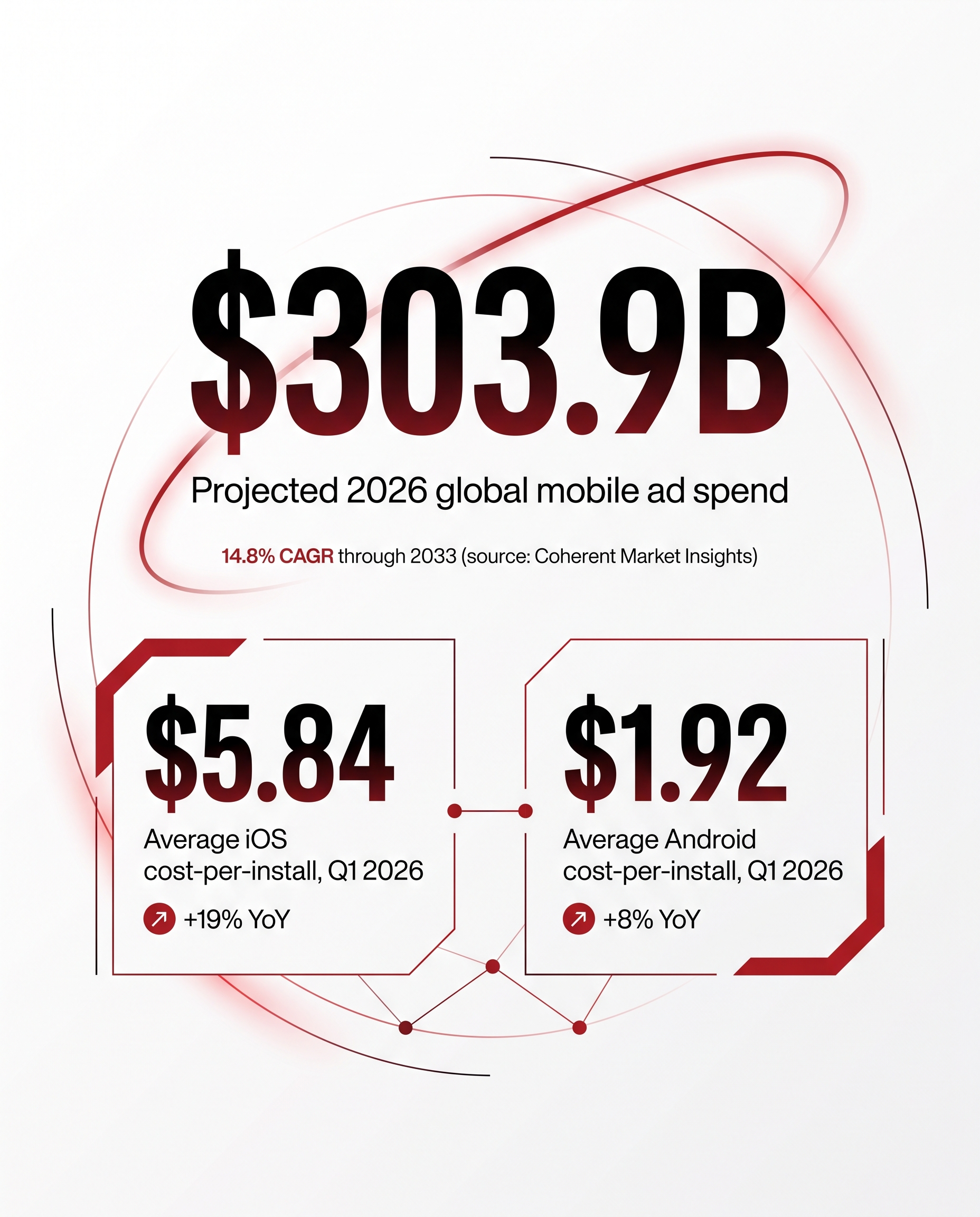
Global mobile advertising spend is projected to reach roughly $303.9 billion in 2026, according to Coherent Market Insights, with the segment compounding at a 14.8% CAGR through 2033 as budgets keep shifting from desktop and open web toward in-app and mobile-web inventory. For app marketers, that growth is concentrated in one brutal metric: average iOS cost-per-install climbed to $5.84 in Q1 2026 (up 19% year-over-year), while Android CPI rose 8% to $1.92, per blended third-party CPI benchmark aggregators (these are industry averages from aggregated network data, not a single audited source) - meaning the network you pick to source installs now moves your unit economics more than almost any other line item in the budget.
The TrafficSigma team researched, compared, and ranked the mobile ad networks that actually matter for app-install and mobile-web campaigns in 2026 - evaluating each one specifically on mobile-native criteria, not generic display-network features. Below are the 10 best mobile advertising platforms for CPI, app-install, and mobile-web traffic this year, including where TrafficSigma fits for mobile push, in-page push, and pop coverage.
What makes a mobile ad network worth your CPI budget?
There's no single "best" mobile ad network for every app - a hyper-casual game studio chasing CPI volume needs a different partner than a fintech app running CPA-gated, high-LTV install campaigns. Instead of a generic ad-network scorecard, we judged each network against the criteria that actually decide whether a mobile advertising platform performs for app-install and mobile-web traffic specifically:
- CPI/app-install support: whether the network runs genuine cost-per-install or cost-per-action pricing natively, not CPI bolted onto a CPM-first display stack, and what real install pricing looks like by GEO and vertical.
- Mobile web and in-app format coverage: whether the network reaches both in-app inventory (rewarded video, playable, interstitial, native) and mobile web formats (push, in-page push, interstitial) rather than one or the other.
- SDK/MMP integration depth: native support for the mobile measurement partners advertisers already run - AppsFlyer, Adjust, Kochava, Singular - since a network that doesn't postback cleanly to your MMP is unusable at real budget regardless of its pricing.
- Mobile-specific fraud filtering: whether the network actively screens for device farms, click injection, click spoofing, and SDK spoofing - the fraud vectors unique to mobile, distinct from generic bot-traffic filtering built for desktop display.
- GEO, device, and carrier targeting granularity: how finely a campaign can be sliced by country, device model, OS version, connection type, and mobile carrier, since carrier-level targeting is what separates a mobile-native network from a repurposed web network.
- Scale: daily active users, monthly impressions, or number of integrated apps/publishers reachable through the network, as a proxy for how fast a campaign can actually spend budget at volume.
- Self-serve accessibility: whether a mid-size advertiser can launch and manage campaigns directly, or whether the network gates access behind a managed-service minimum.
This section is the reason the list below isn't a rehash of generic "top ad networks" content - every entry was checked against the same seven mobile-native criteria, and none of them substitute for a broader self-serve programmatic review; see our companion guide on self-serve ad platforms for the wider multi-format landscape beyond mobile-specific app-install buying.
Get iGaming traffic from TrafficSigma now!
Which 10 mobile ad networks earn their CPI and fraud-filtering claims?
The TrafficSigma team runs mobile-format traffic - push, in-page push, and pop - at scale daily across 248+ GEOs, which is why this list is built from the buying side: real SDK integrations, real fraud-filtering tradeoffs, and real GEO/carrier targeting menus, not just marketing pages. Here is the full list before the detailed breakdown:
- Liftoff
- ironSource (Unity LevelPlay)
- AppLovin
- Digital Turbine
- Moloco
- Mintegral
- Smadex
- PropellerAds
- RichAds
- TrafficSigma
Now let's review each mobile ad network in detail.
1. Liftoff
Liftoff is a mobile app-install and re-engagement network founded in 2012 and headquartered in Redwood City, California, which merged with fellow mobile ad network Vungle in 2021 to form one of the largest independent mobile growth platforms outside the walled gardens. It runs primarily on CPI and CPA pricing - advertisers pay per install or per in-app action rather than per impression, with machine-learning bid optimization tuned specifically for install and post-install event value.
Average CPI benchmarks across the industry now sit around $1.92 on Android and $5.84 on iOS as of Q1 2026, and Liftoff's mobile-first stack supports rewarded video, playable ads, native, and mobile-video formats across its network. The platform integrates with the major MMPs - AppsFlyer, Adjust, and Kochava - for install and event postbacks, which is table stakes for any UA team running attribution outside a single walled garden.
Liftoff's post-Vungle combined platform gives advertisers access to both demand-side app-install buying and supply-side in-app monetization from one company, which simplifies vendor management for studios running both user acquisition and ad monetization simultaneously.
Highlights:
- Type/Category: Mobile app-install and re-engagement network (CPI/CPA)
- Terms/Pricing: CPI, CPC, CPA, CPM; Android CPI ~$1.92, iOS CPI ~$5.84 industry average
- Cadence/Frequency: Managed and self-serve campaign options
- Requirements/Minimum: Managed onboarding for most advertisers; MMP integration required
2. ironSource (Unity LevelPlay)
ironSource is a mobile app-install and mediation network founded in 2010 in Tel Aviv, which merged with Unity Technologies in a completed $4.4 billion stock deal in November 2022; its user-acquisition and mediation stack now operates under the Unity LevelPlay brand. The network specializes in driving install and in-app-purchase campaigns for mobile games and apps using machine-learning bid optimization tied to ROAS goals rather than flat CPI targets.
Advertisers can set campaigns to optimize toward return-on-ad-spend based on in-app purchase value, not just raw install volume, and the platform's LevelPlay mediation layer gives it direct access to ad inventory across a large network of mobile games and apps for both install-driving and monetization. ironSource holds the Trustworthy Accountability Group's "Certified Against Fraud" seal and has an active technical partnership with Kochava on click-fraud detection, addressing device-farm and click-injection patterns specific to mobile install fraud.
Its 2019-launched LevelPlay mediation product means ironSource campaigns run inside a stack that also handles monetization for thousands of publishers, giving advertisers unusually deep visibility into which in-app placements actually convert.
Highlights:
- Type/Category: Mobile app-install network + mediation (LevelPlay)
- Terms/Pricing: CPI, ROAS-goal bidding via machine-learning optimization
- Cadence/Frequency: Managed and self-serve campaign options
- Requirements/Minimum: MMP integration required; TAG Certified Against Fraud
3. AppLovin
AppLovin is a mobile advertising and app-monetization company founded in 2012 by Adam Foroughi, John Krystynak, and Andrew Karam, headquartered in Palo Alto, California, and built around Axon - its proprietary AI engine for ad targeting, creative optimization, and bid decisions, recently rebranded as "AppLovin Ads." The network reaches more than one billion daily active users through its mobile gaming inventory and connects to a network of over 140,000 mobile apps for both user-acquisition and monetization purposes.
AppLovin opened Axon's self-serve advertiser access to the general public in June 2026, removing the referral-code requirement that previously gated the platform; unconfirmed reports have circulated an average projected first-year ad spend figure for new self-serve advertisers, but treat that number as unverified. The Axon engine was built over more than a decade of mobile-gaming install optimization, using predictive, real-time bid adjustment to find users likely to install and retain rather than just click.
For app marketers, AppLovin's scale advantage is that its demand and supply sides sit inside the same company, so bid data from monetizing 140,000+ apps directly informs install-targeting decisions on the advertiser side.
Highlights:
- Type/Category: Mobile app-install network + AI bidding engine (Axon/AppLovin Ads)
- Terms/Pricing: CPI-based, AI-optimized bidding; self-serve since June 2026
- Cadence/Frequency: Self-serve, always-on campaign launch
- Requirements/Minimum: No referral code required as of June 2026; MMP integration required
4. Digital Turbine
Digital Turbine is a mobile advertising and on-device media company headquartered in Austin, Texas, with technology embedded across nearly 3 billion devices and reach into more than 80,000 applications through its App Growth Platform (AGP) and On Device Solutions (ODS) businesses. Its distinctive mechanic is direct carrier and OEM device placement - pre-loaded app recommendations and on-device content surfaces built through partnerships with wireless carriers and phone manufacturers, not just in-app or mobile-web ad slots.
In its fiscal Q4 2026 results, Digital Turbine reported AGP revenue up 57% year-over-year and DT Exchange (its programmatic exchange) up more than 60%, with the company citing roughly 40% higher AGP rates from improved AI/ML targeting. Because its ODS inventory sits at the carrier and device level, Digital Turbine offers a form of carrier-level placement most app-only networks structurally can't replicate - ad and app-discovery placements that appear during device setup and default-app selection flows.
That carrier-and-OEM distribution model makes Digital Turbine especially relevant for app marketers targeting emerging markets, where carrier-subsidized devices and default app placements still drive a meaningful share of first-time app discovery.
Highlights:
- Type/Category: On-device media + app-install network (AGP / ODS / DT Exchange)
- Terms/Pricing: CPI and programmatic exchange pricing via DT Exchange
- Cadence/Frequency: Managed carrier/OEM placements plus programmatic self-serve exchange
- Requirements/Minimum: Managed onboarding for carrier/OEM inventory
Start scaling your campaigns with TrafficSigma
5. Moloco
Moloco is a machine-learning-driven mobile app-install network founded in 2013 and headquartered in Redwood City, California, which AppGoblin's 2025 report named the fastest-growing ad network of the year by net-new publisher integrations - the number of publishers monetizing with the Moloco SDK more than doubled over 2025. Its ads reach a large base of independent apps (specific figures like "2.8 million" are unconfirmed against a primary source), concentrated in gaming, news, entertainment, and lifestyle categories where users are typically deeply engaged.
Moloco supports all major MMPs for install, event, and revenue postbacks, plus native SKAdNetwork support for iOS attribution under Apple's privacy framework. Its anti-fraud system integrates directly with MMP-side fraud tools - when an advertiser uses AppsFlyer's Protect360 or Adjust's Fraud Prevention Suite, Moloco receives rejected-install data back in real time with the specific rejection reason, closing the loop between network-side and MMP-side fraud detection.
The company's 2026 expansion into performance CTV, built on the same targeting engine as its mobile install product, signals it's scaling the machine-learning core beyond mobile - but the mobile app-install product remains its primary use case for UA teams today.
Highlights:
- Type/Category: Machine-learning mobile app-install network
- Terms/Pricing: CPI/performance-based bidding via ML optimization
- Cadence/Frequency: Managed and self-serve campaign options
- Requirements/Minimum: MMP integration required (AppsFlyer, Adjust, Kochava, Singular)
6. Mintegral
Mintegral is a programmatic mobile app-install network launched as a brand in 2016 as part of Mobvista (Singapore-headquartered, and itself founded in 2013), integrating with thousands of mobile app developers worldwide for both demand and supply; Mintegral does not publish a specific daily-impression figure, so treat any such number as unconfirmed. Campaigns run on Install, Impression, or ROAS goal types, corresponding to CPI, CPM, and target-ROAS bidding strategies respectively - giving UA teams a choice between raw install-volume campaigns and value-optimized ones from the same dashboard.
Mintegral's self-serve platform, distributed through its XMP cross-channel media-buying layer, supports interactive and playable creative formats alongside standard video and static app-install ads, which the company has invested in specifically to lift install-to-open conversion rates on gaming and app-commerce offers. The Mintegral SDK has been open-source since around 2018-2020 (sources give different years), giving publishers and advertisers direct visibility into how install and impression data is collected and reported rather than relying on a black-box measurement layer.
For UA teams buying across Asia-Pacific inventory specifically, Mintegral's developer-integration base gives it meaningfully denser regional supply than most Western-headquartered networks can match.
Highlights:
- Type/Category: Programmatic mobile app-install network (Mobvista)
- Terms/Pricing: CPI, CPM, and target-ROAS bidding
- Cadence/Frequency: Self-serve via XMP platform
- Requirements/Minimum: MMP integration for install/event postbacks
How to Buy Website Traffic Without Buying Bots: A 2026 Buyer's Guide - Mobile install fraud (device farms, click injection, SDK spoofing) is a different animal from open-web bot traffic, and it costs real budget at every network above. Our companion guide breaks down how traffic-quality filtering actually works across formats, and what to check before you scale spend on any new source. Continue reading on the TrafficSigma blog.
7. Smadex
Smadex is a mobile-first demand-side platform founded in 2011 and headquartered in Barcelona, Spain, running performance and brand campaigns across in-app, mobile web, and connected-TV inventory from one programmatic buying interface. It's one of the few networks on this list built to buy in-app and mobile-web app-install traffic side by side in the same campaign rather than treating mobile web as an afterthought bolted onto an app-only stack.
Smadex reports client campaigns sustaining a 60% ROAS over six months on its App-to-Web product, and the platform holds IAB Gold Standard Certification and the Good Practice Principles accreditation from media auditor ABC, alongside recognition from measurement firm Kochava for fraud-free install delivery. Its programmatic core supports SKAdNetwork-based iOS attribution and integrates with standard MMP stacks for Android install and event tracking.
Because Smadex buys mobile web and in-app inventory from the same DSP, it's a genuinely useful option for advertisers running mixed app-install and mobile-web-conversion campaigns who don't want to split budget and reporting across two separate platforms.
Highlights:
- Type/Category: Mobile-first DSP (in-app, mobile web, CTV)
- Terms/Pricing: Performance-based (CPI/CPA) and brand CPM campaigns
- Cadence/Frequency: Managed and programmatic self-serve options
- Requirements/Minimum: MMP integration; SKAdNetwork support for iOS
8. PropellerAds
PropellerAds is a multisource self-serve advertising platform founded in 2011 and headquartered in Limassol, Cyprus, delivering up to 15 billion daily impressions with broad global GEO coverage (the 195+ GEO figure on PropellerAds' own site is scoped to its popunder inventory specifically, not push/mobile) - and while it's built as a general-purpose push/pop/native network rather than a dedicated CPI specialist, its mobile push, in-page push, and interstitial formats see heavy use for mobile-web app-install and app-promotion campaigns. Its CPA Goal 2.0 pricing model lets advertisers set a target cost-per-action and let the platform's algorithm auto-optimize bids toward it, which is the closest thing PropellerAds offers to genuine CPI-style pricing.
Self-serve minimum deposit is $100 by card, and mobile push CPC starts around $0.005 depending on GEO and device targeting, with granular targeting across device, OS, carrier, and connection type available in the same self-serve dashboard. PropellerAds' mobile-specific fraud filtering screens for device-farm and bot-traffic patterns on its push and in-page push inventory, though its fraud stack is built for its native push/pop ecosystem rather than app-install-specific vectors like SDK spoofing.
For app marketers already running mobile-web push or in-page push to drive app-store landing-page traffic, PropellerAds' scale and self-serve accessibility make it a reasonable low-minimum entry point alongside a dedicated CPI network.
Highlights:
- Type/Category: Multi-format self-serve network (push, in-page push, interstitial, native)
- Terms/Pricing: Push CPC from ~$0.005; CPA Goal 2.0 available
- Cadence/Frequency: Self-serve, always-on campaign launch
- Requirements/Minimum: $100 minimum deposit (card)
Scale your mobile-web traffic with TrafficSigma
9. RichAds
RichAds is a self-serve ad network founded in 2018 and headquartered in Limassol, Cyprus, delivering roughly 7 billion daily impressions across 220 GEOs through eight traffic formats, with push and Telegram inventory the most commonly used for mobile app-install and mobile-web promotion. Like PropellerAds, it's not a CPI-native specialist - it prices on CPC/CPM - but its push and in-page push formats are widely used by mobile affiliates to drive app-store and landing-page installs at a lower minimum than dedicated UA networks require.
Self-serve minimum deposit is $150, with push ads starting from $0.003-0.005 CPC and native ads from $0.001 CPC, and the platform integrates with 16 third-party trackers for attribution - useful for teams that already run an MMP or tracker stack and don't want to switch tools to test a new source. RichAds layers AI-based bid and targeting automation, plus fraud-prevention filtering, on top of its self-serve dashboard.
For mobile-web-driven app-install funnels specifically - where the goal is a push or in-page push click into an app-store landing page rather than a direct in-app SDK-tracked install - RichAds' low deposit and broad GEO coverage make it a workable complement to a dedicated CPI network above.
Highlights:
- Type/Category: Multi-format self-serve network (push, native, pop, Telegram)
- Terms/Pricing: Push from $0.003-0.005 CPC; native from $0.001 CPC
- Cadence/Frequency: Self-serve, always-on campaign launch
- Requirements/Minimum: $150 minimum deposit
10. TrafficSigma
TrafficSigma is a global self-serve ad network built for performance marketers running iGaming, Finance/Forex, Nutra, and other high-payout verticals, covering Telegram Mini App ads, push notifications, in-page push, pop/popunder, domain redirect, native, and calendar push traffic across 248+ GEOs. It isn't a dedicated app-install/CPI network - TrafficSigma doesn't run native CPI bidding - but its mobile push and in-page push formats are heavily used by affiliates to drive mobile-web traffic into app-store landing pages and mobile offer funnels alongside dedicated UA networks.
Push and Telegram ads start from $0.006 CPC and pop/popunder traffic starts from $1.00 CPM, with granular GEO, device, OS, and carrier-level targeting available from account creation - the carrier-targeting layer specifically is relevant for mobile-web app-promotion campaigns that need to isolate specific mobile operators in a GEO rather than targeting the country as a whole. The platform runs on 5B+ daily push and Telegram impressions and 4B+ daily pop impressions.
Campaigns are backed by 3-level fraud protection and vetted premium sources, which matters for mobile-web app-promotion traffic specifically, since device-farm and bot patterns hit push and pop inventory in largely the same way they hit in-app CPI traffic. For affiliates running iGaming or Finance/Forex mobile offers who need mobile-web reach rather than in-app SDK-tracked installs, TrafficSigma's carrier-level targeting and format breadth fill a genuinely different gap than the CPI-native networks above.
Highlights:
- Type/Category: Multi-format self-serve network (push, in-page push, pop/popunder, Telegram Mini App)
- Terms/Pricing: Push/Telegram from $0.006 CPC; pop/popunder from $1.00 CPM
- Cadence/Frequency: Self-serve, always-on campaign launch
- Requirements/Minimum: Self-serve account, no forced managed minimum
Launch your next campaign on TrafficSigma traffic
All 10 mobile networks' pricing, terms, and minimum requirements at a glance
These 10 mobile ad networks can look interchangeable from their homepages - "AI-powered," "global scale," "fraud protection" appear on nearly every one - but their pricing models, format coverage, and fraud-filtering depth differ a lot in practice. This table pulls the fields that actually decide fit, in the same order used in every entry above.
| # | Network | Type/Category | Terms/Pricing | Cadence/Frequency | Requirements/Minimum |
|---|---|---|---|---|---|
| 1 | Liftoff | Mobile app-install + re-engagement (CPI/CPA) | CPI/CPC/CPA/CPM; Android ~$1.92, iOS ~$5.84 CPI avg. | Managed + self-serve | MMP integration required |
| 2 | ironSource (Unity LevelPlay) | App-install network + mediation | CPI, ROAS-goal ML bidding | Managed + self-serve | MMP integration; TAG Certified |
| 3 | AppLovin | App-install network + AI engine (Axon) | CPI, AI-optimized bidding | Self-serve (since June 2026) | No referral code required; MMP integration |
| 4 | Digital Turbine | On-device media + app-install (AGP/ODS) | CPI + programmatic exchange | Managed carrier/OEM + self-serve exchange | Managed onboarding for ODS inventory |
| 5 | Moloco | ML-driven app-install network | CPI/performance ML bidding | Managed + self-serve | MMP integration (AppsFlyer, Adjust, Kochava, Singular) |
| 6 | Mintegral | Programmatic app-install network | CPI, CPM, target-ROAS | Self-serve via XMP | MMP integration for postbacks |
| 7 | Smadex | Mobile-first DSP (app + web + CTV) | CPI/CPA + brand CPM | Managed + programmatic self-serve | MMP integration; SKAdNetwork support |
| 8 | PropellerAds | Multi-format self-serve (push/pop/native) | Push CPC from ~$0.005; CPA Goal 2.0 | Self-serve | $100 minimum deposit |
| 9 | RichAds | Multi-format self-serve (push/native/Telegram) | Push from $0.003-0.005 CPC | Self-serve | $150 minimum deposit |
| 10 | TrafficSigma | Multi-format self-serve (push/in-page push/pop/Telegram) | Push/Telegram from $0.006 CPC; pop from $1.00 CPM | Self-serve | Self-serve account, no forced minimum |
No single best mobile ad network exists: only the one that matches your install goal
Picking the right mobile ad network in 2026 comes down to three factors: whether it runs genuine CPI/CPA pricing versus a CPM-first stack you have to bend to fit installs, how deep its SDK/MMP integration goes with the attribution stack you already run, and how seriously it filters mobile-specific fraud vectors like device farms and click injection rather than generic bot detection built for desktop display. Get those three right and the GEO/carrier targeting granularity and raw scale numbers become the tiebreakers between otherwise-qualified networks.
For UA teams running dedicated in-app CPI campaigns, the seven specialist networks above - Liftoff, ironSource/Unity LevelPlay, AppLovin, Digital Turbine, Moloco, Mintegral, and Smadex - cover the core of that market. But mobile-web-driven app promotion is a different motion, and that's where TrafficSigma's push, in-page push, and carrier-targeted mobile traffic fits: not a CPI replacement, but a genuinely complementary mobile-web channel for affiliates and media buyers who already need to reach mobile users outside the app-install SDK stack, especially in iGaming, Finance/Forex, and other high-payout verticals.